This article was published in the July 2026 issue of the monthly magazine Antoque Toy World on pages 52-53-54.
In the prehistory of the development of tin toys, there were no real mechanical motors yet, so Martin started his first toy with a very simple but extremely efficient motion mechanism.
In the early days Martin used a very simpel rubber band (elastic) as the drive.
By turning it on, the toy started to move.
The system consists mainly of a crank, a rubber band and a movement mechanism.
The drive mechanism was adjusted for each toy, such as up and down, right, left, spinning etc.
As an example, the first piece of Martin: the fish from 1878 – Poisson Nageur
Martin started in 1875 in a shed behind his house, with his first attempts to make toys but in 1878 the first real toy was a real swimming fish with patent number 128445 from Jan-01-1879 and started with the production number 100
This Fish is about 19 cm / 7,5 inc long
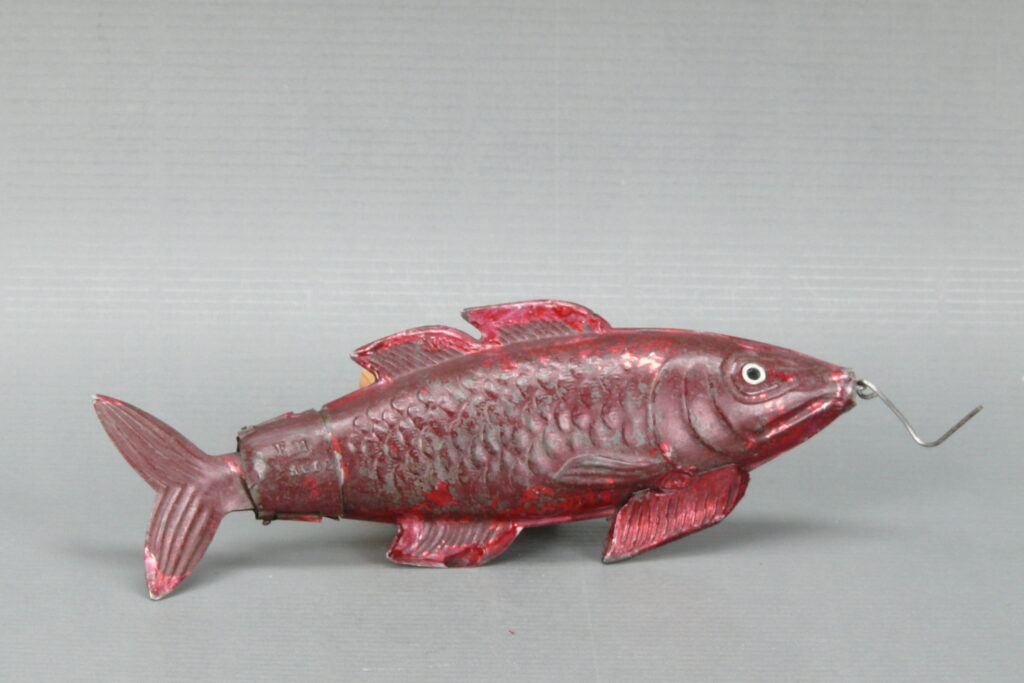
Courtesy Spielmuseum Soltau Germany
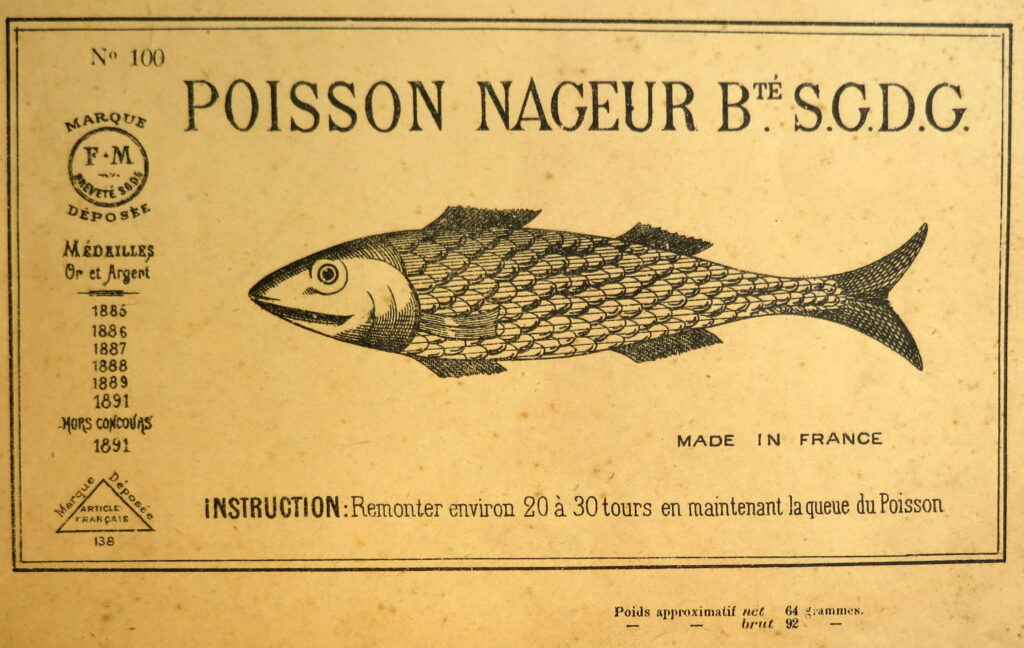
Here is a page from the original catalog that is in my personal collection
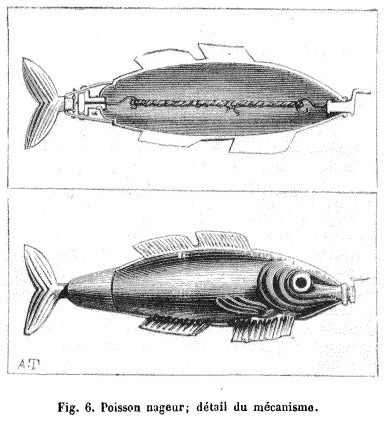
Drawing Source La Nature : (Cnum – Digital Conservatory of Arts and Crafts – http://cnum.cnam.fr)
The crank is in the nose, inside the fish is the rubber band and the mechanism is on the tail.
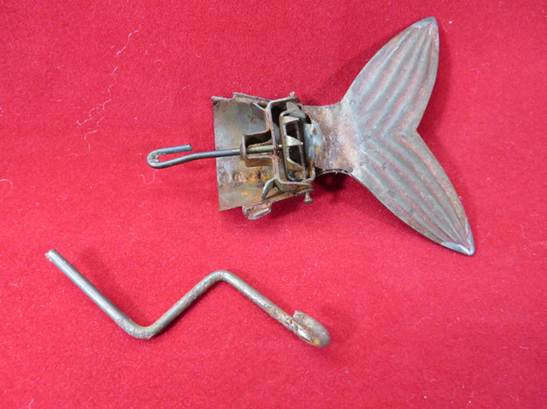
Parts: between the both hooks coms the rubber band, see below
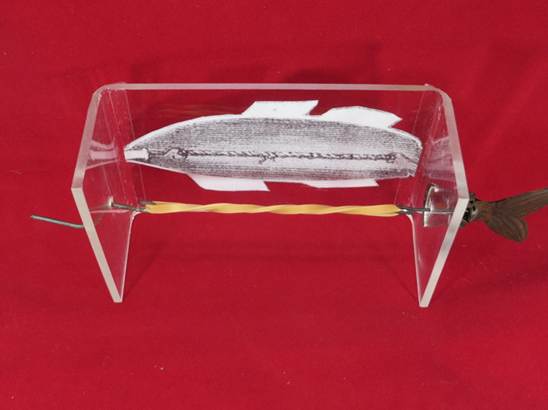
This demo model is made with an original crank and the mechanism with the tail.
In this demo model you can see clearly the mechanism in operation,
By turning the crank and hold the tail, the rubber band is tightened (twisted)
The other side of the rubber band is hooked onto the movement mechanism, the tail.
When you release the tail again, the tail swings from right to left so that the illusion of swimming is simulated.
Simple but effective.
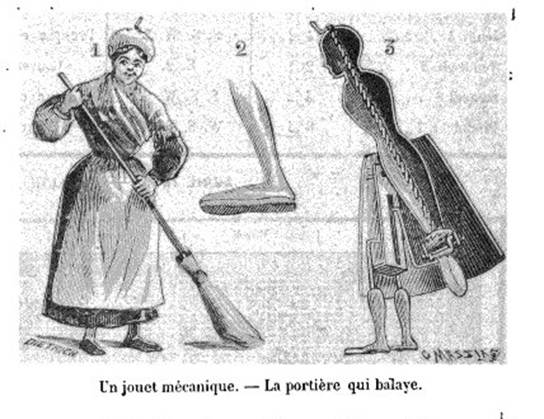
Another exemple The “Ma Portière” from 1895 > Source La Nature : (Cnum – Digital Conservatory of Arts and Crafts – http://cnum.cnam.fr)
In this example of the “Ma Portière” the upper body and the broom moves from left to right, the same movement as the tail of the fish “Poisson Nageur”, the crank is on top of the head.
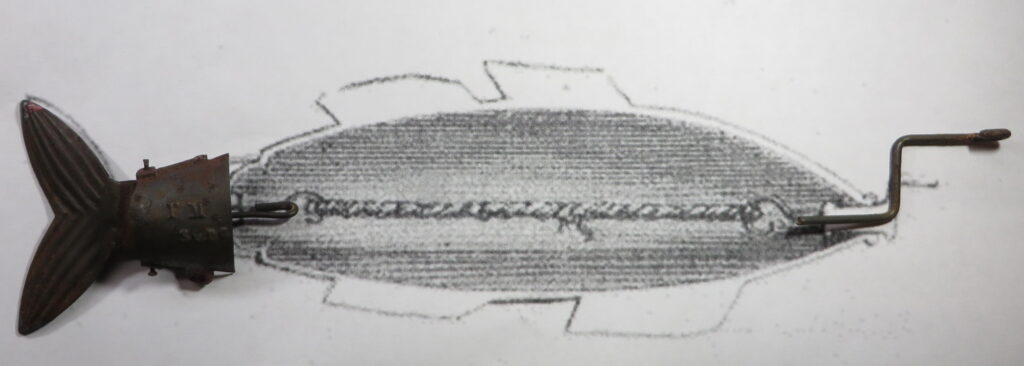
The only drawback is that the rubber band can age and then break quickly.
If it breaks, the hook and mechanism will fall off and mostly get lost.
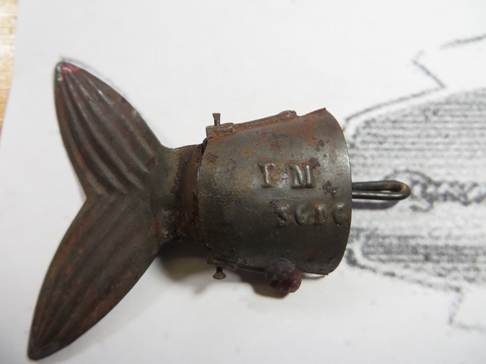
Detail of the fish tale
Martin sold the patent for a swimming fish with a rubber band engine to the Englisch company Cremer Dolls Toys Games 210 Regent street London
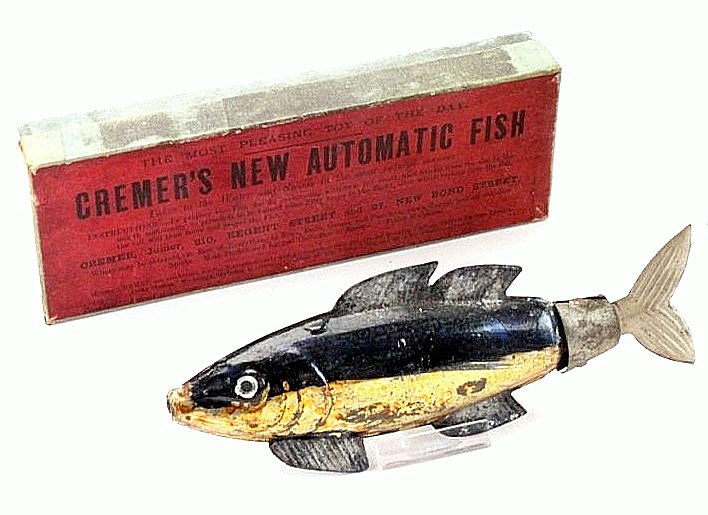
Courtesy: Pook & Pook with Noel Barrett
and that was the beginning of his fortune, he started in 1880 his first factory.