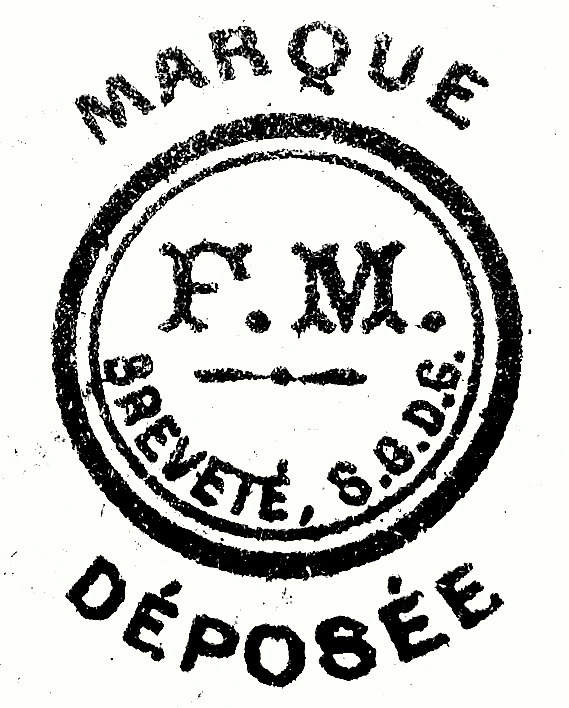
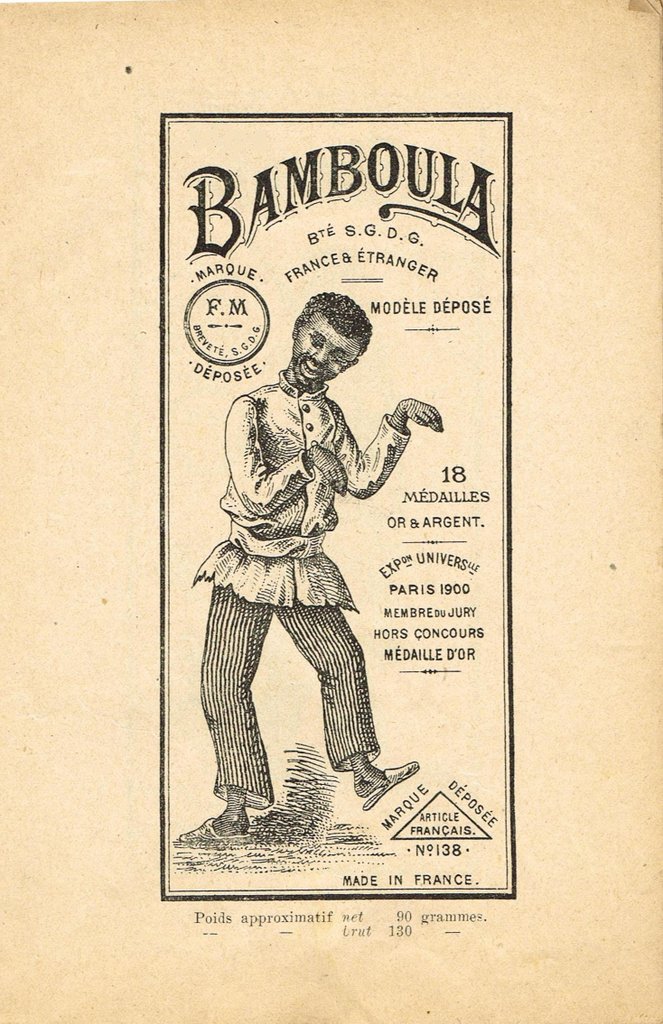
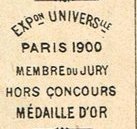
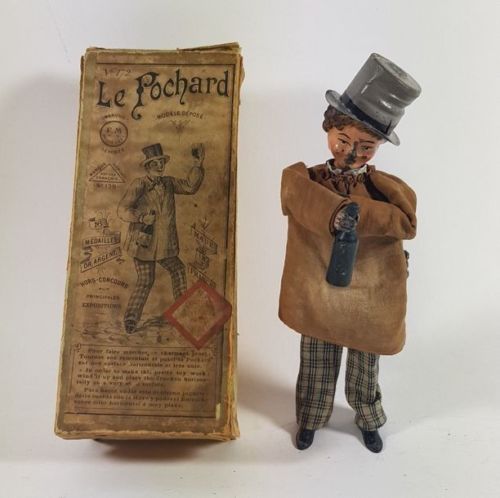
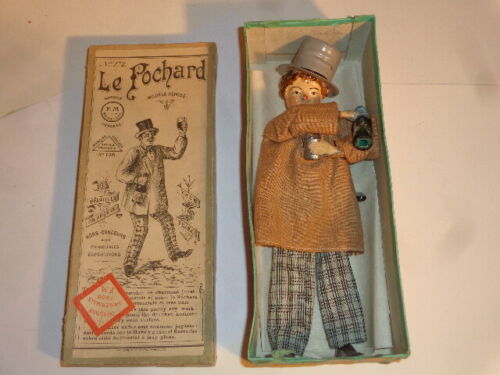
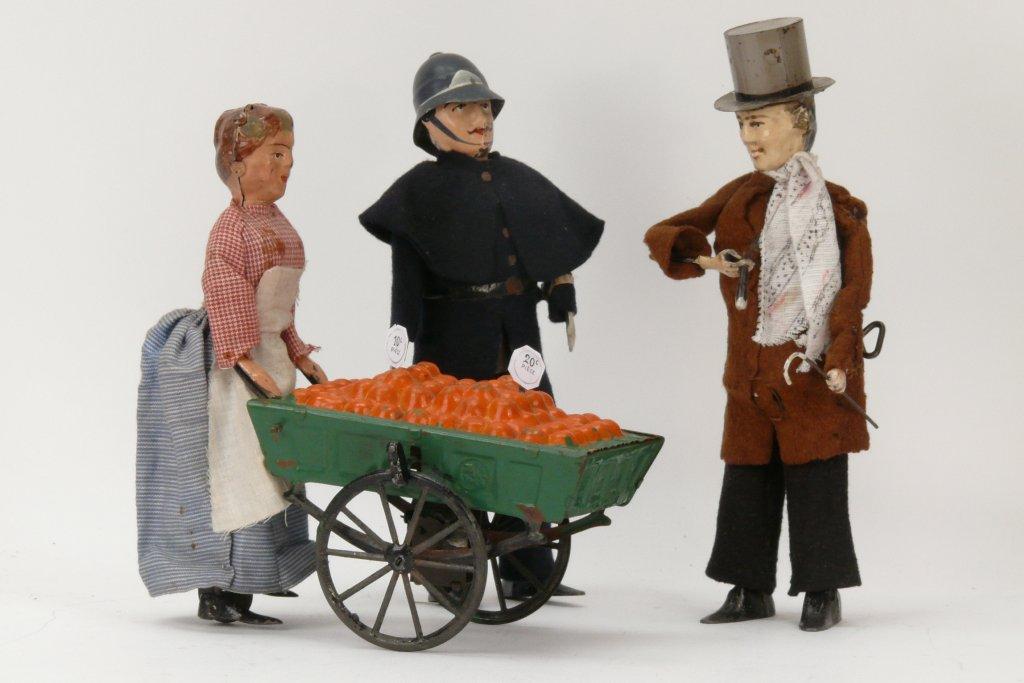
In the year 1900 the 13th universal World Exhibition was in Paris. Fernand Martin participated in this exhibition and was also a jury member of the “Hors Concours Médaille D’or ” as can be read on the box and on the catalog picture of the Bamboula no 179.
This World exhibition lasted from April 15 to November 12, 1900.
During this exhibition many products were sold to the public by business exhibitors, but street vendors in the streets of Paris also sold more than normal during that period.
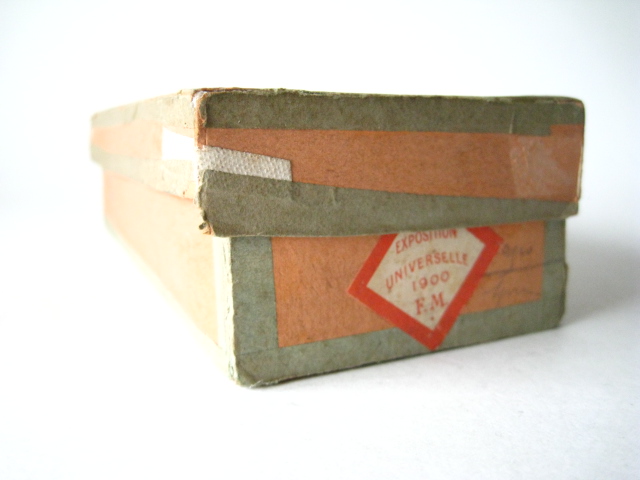
I have found three boxes of the Le Pochard number 172 produced from the year 1899 with a additional reference to this exhibition.
This “Le Pochard” is familiar to all Martin collectors and it has also been produced for a long time and is one of the most renowned Martin’s .
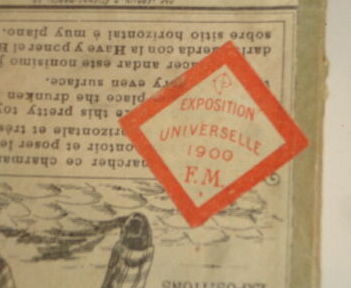
This additional reference is a loose sticker that is stuck on the boxes The sticker on the first box is difficult to read but the other two boxes are much clearer to read. The sticker on box three is not on the front but on the top of the box
Exposition Universelle 1900 F.M.
We can assume that these pieces were sold during this world exhibition in 1900, but it is also possible that the stickers were placed as advertisements well before the world exhibition to draw attention to this exhibition. These boxes with toys are therefore very easy to date. You also see that both drunks are dressed the same.
I do not know if boxes of other Martin toys were also provided with this sticker, but perhaps one of the readers of this blog has an answer, please let me know.
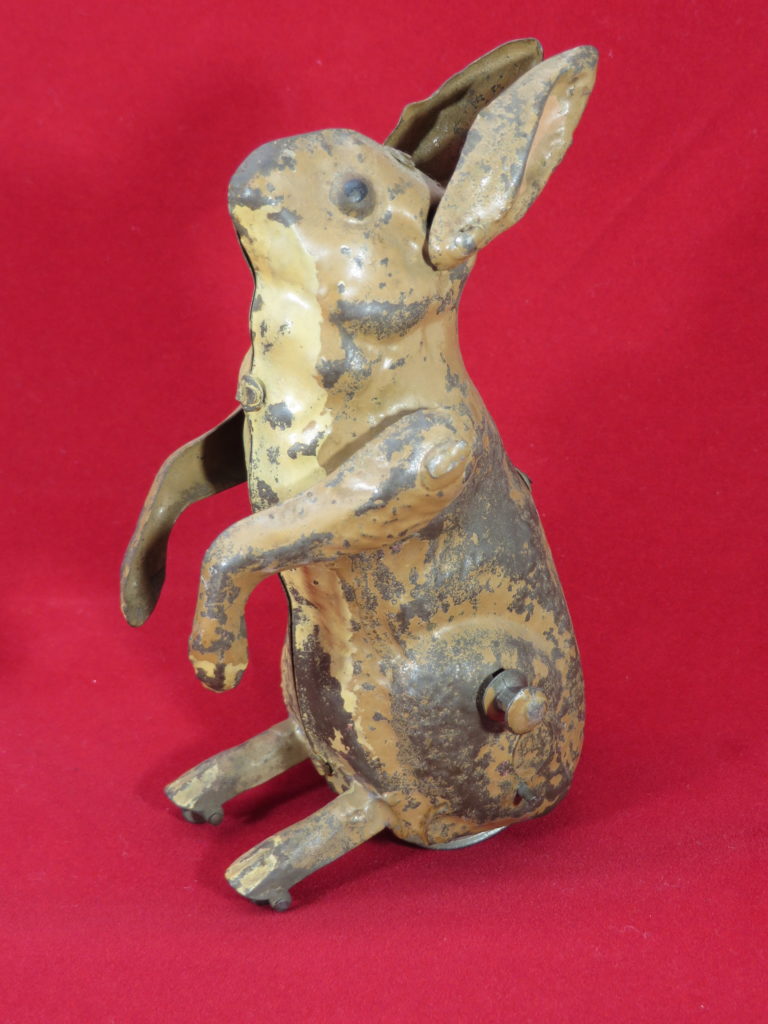
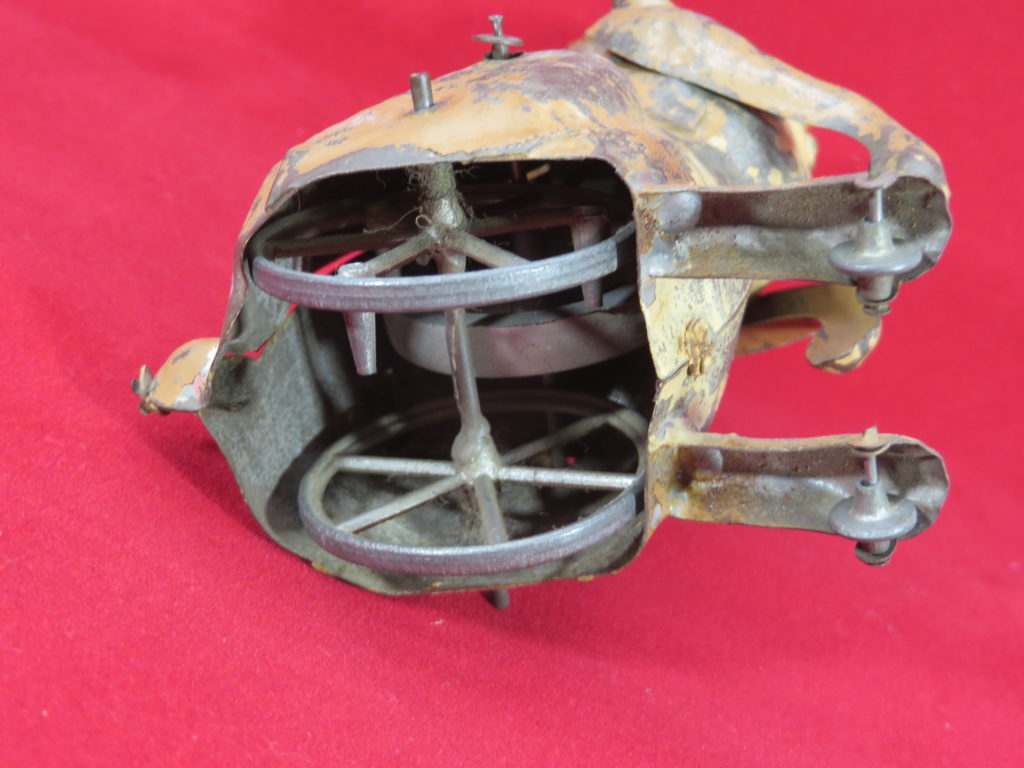
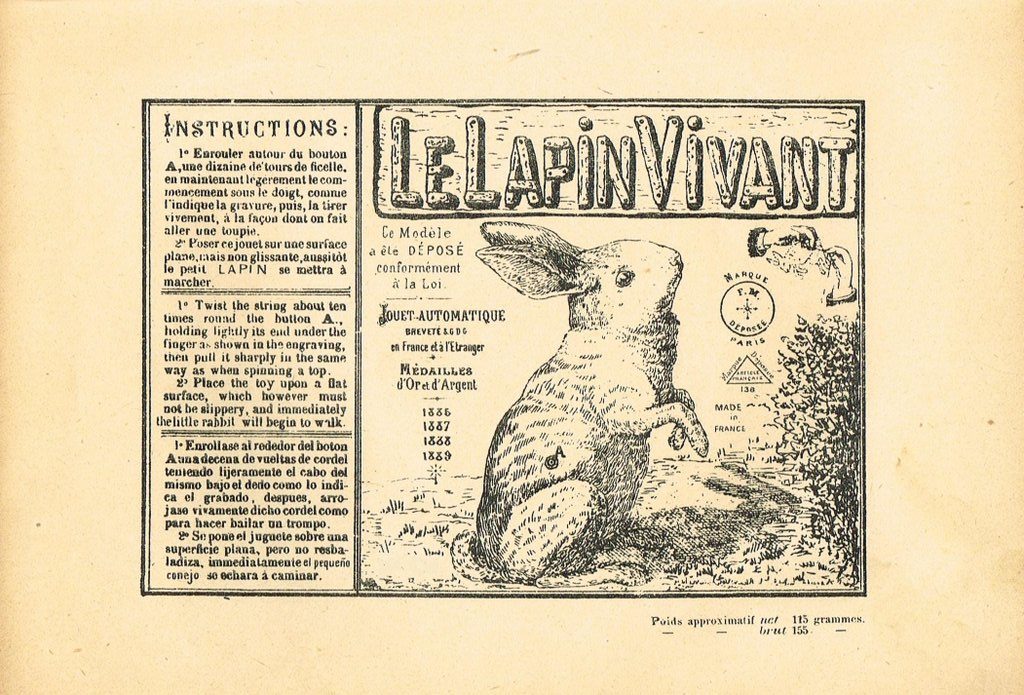
This rabbit is produced from 1890 and quite rare In the 2014 book: Fernand Martin Toymaker in Paris, the Le Lapin Vivant is listed on page 59 with the number 32 but the new number is 114 I know some color varieties such as white, light brown and dark brown.
It is a fairly small bunny with a height of 13 cm. After winding up, he moves forward and his ears and arms move. Immediately below the winding roll it is marked with the old known logo of Martin, the circle with the letters “F.M.” and “depose”
So far I have only seen versions with a flywheel drive. Recognizable on the side where the wheel is to wrap the rope.
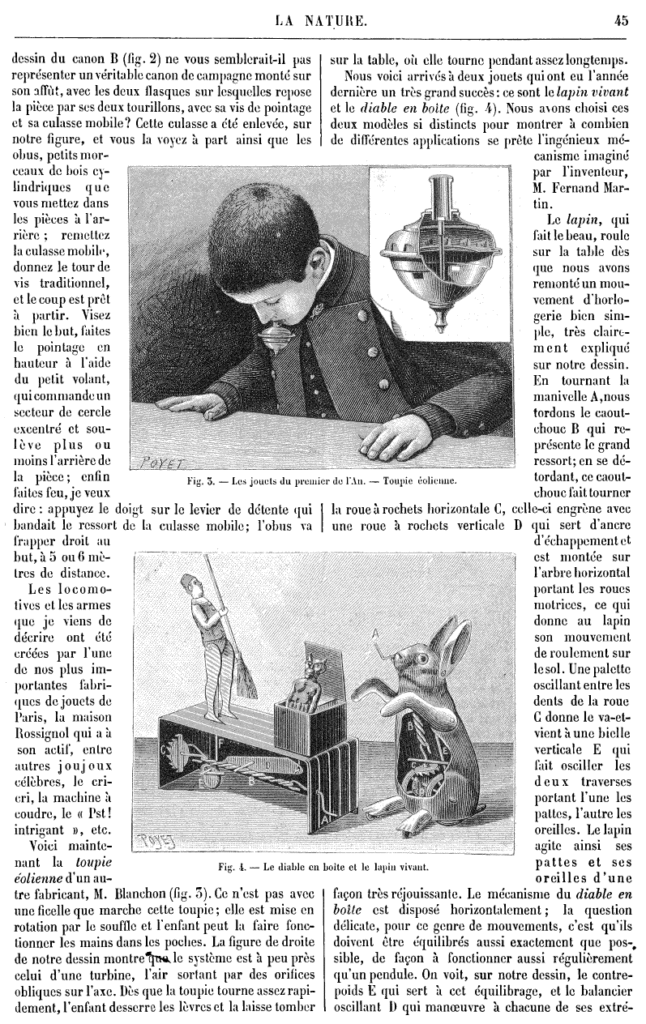
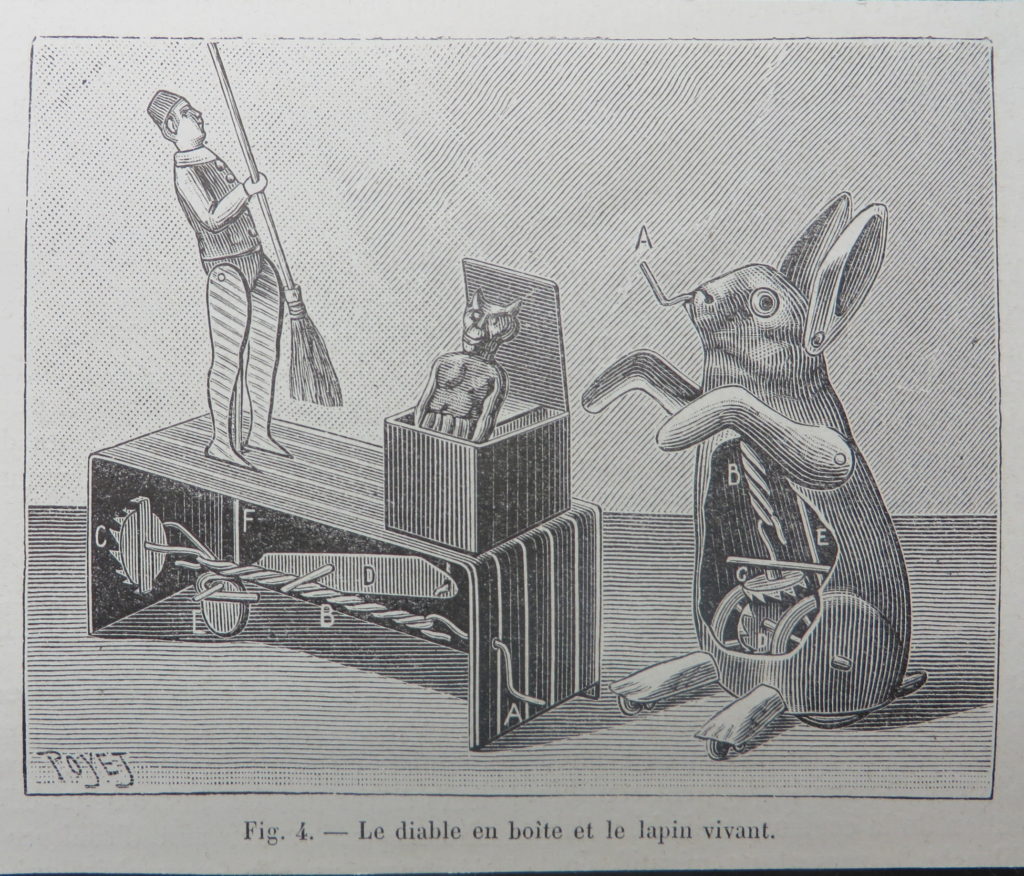
With the rubber band version I have never seen myself I recently bought a series of 4 little etchings from 1892 with images of toys. On one of the etchings this Le Lapin Vivant with the version with a rubber belt drive is shown. The original etching is very small; approximately 8×10 cm In the French technical year magazine: La Nature from 1892 on page 45 this drawing / etching is depicted on which a beautifully open worked Le Pantin Vivant can be seen.
Source: (Cnum – Digital Conservatory of Arts and Crafts – http://cnum.cnam.fr)
This etching is made by mr. Louis Poyet Mr Poyet made many etchings of toys for the technical magazin “La Nature”, he therefore regularly visited toy factories, including of course the Fernand Martin factory to make a lot of etchings of the latest new toys.
A very special toy with an ingenious mechanism L’homme toupie made by Victor Bonnet from Paris, the last owner of the Fernand Martin toy factory in Paris. This clown has the product number 252 It has been produced from around 1921/1922 This toy can be winded by means of a separate key. The height is 19 cm = 7,5 inch.
two different color varieties
After winding, place him on top of his head / hat on a flat table and let go. (in his hat is a clearly visible screw on which the whole turns) He then starts to turn around his axis and at some point his hands slowly move towards the table, then stops turning and then pushes his head / hat away from the table. His legs then separate and back together. Then his head / hat returns to the table and everything starts all over again. The manufacturer calls it a spinning top but therefore a very special ingenious spinning top. He is now collected by collectors of tin toys and then mainly collectors of Fernand Martin toys. He is therefore also collected by spinning tops collectors and collectors of circus acts. It has a tin body, head, feet and hands. The arms and legs are made of metal wire. The feet, hands and the head with the hat are hand painted. Furthermore, the whole is provided with colorful fabric clothing.
The top of the hat with the brand name and the named screw –the hand-painted face– the keyhole on the back and an image from a catalog from the late 1920”s .
To wind it up, there is a keyhole on the back What is important at purchase this toy, look at this keyhole, there is normally a Brass ring with disc attached in the fabric clothing, the disc is clothed with fabric, but very often this ring with disc is torn out and disappeared due to frequent use. The clown is marked on top of the hat with the text: Article Francais V.B & Cie Paris.
This article is published in the ATW Antique Toy World magazine of March 2020-Volume 50- No3. Read that article here but now with a very recently found additional supplement. This additional supplement was unfortunately too late for publication in the ATW.
The Martin period is brought together from the beginning of the first Fernand Martin toy the POISSON NAGEUR in 1878 during the move of Victor Bonnet from the original old Fernand Martin factory on the 88 Boulevard de Menilmontant Paris to another location in 1934 The last toy we now, till now, was the VOITURE NOUNOU POUPON with number 265
Until now we thought that this VOITURE NOUNOU POUPON with number 265 was the very last “Martin” produced in the factory on the 88 Boulevard de Menilmontant Paris, but that is now changing. We can now add this extra number 266 to it. And maybe there are more extra numbers to discover.
I have now found a new piece with number 266 on the box. It is a pistol with the name LE COSTAUD And luckily with the original box in a fairly good condition so we now for sure that it has number 266.
Dimensions box approximately 2,5 x 10,5 x 16,5 cm (1 x 4,5 x 6,5 inch) Dimensions pistol approximately 11,5 x15 cm (4,5 x 6 inch) I can say that we have found another piece of the big “Martin” puzzle.
And I have an original bill from Victor Bonnet in my collection that includes this pistol. The bill dates from June 16, 1933 and this bill also shows the old trusted location of the original old Fernand Martin factory on 88 Boulevard de Menilmontant Paris.
On this bill there are three well-known Bonnet pistols: –the PAN PAN (number 247) –the TAPE FORT (number 262) –the FLAC (number 256) And now the unknown LE COSTAUD with number 266. But there is still another unknown part on this bill under the name: “EPERVIER” in English this means (Sperrow) Hawk. I think this is also a pistol, because I have often seen tin toy pistols with the name Hawk but till now not from Victor Bonnet but I am not sure yet.
And now the recently found addition:
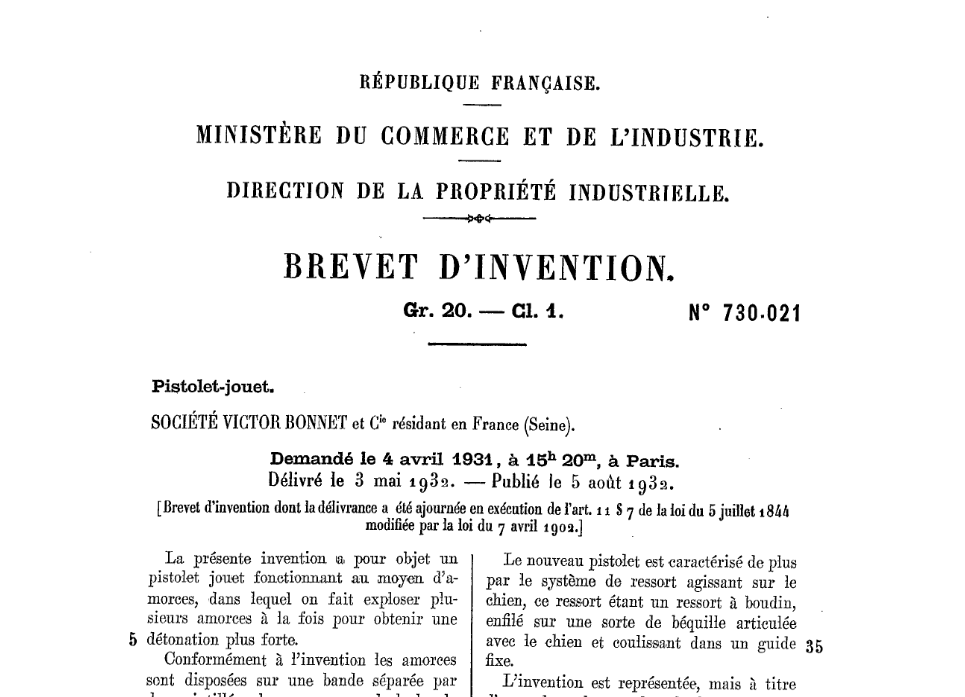
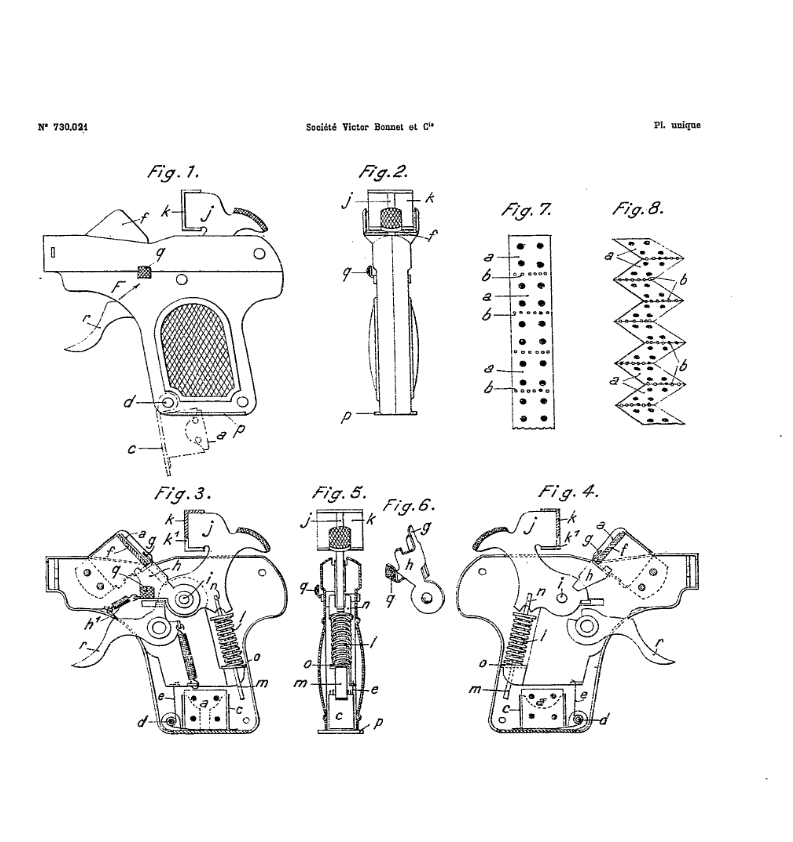
I very recently found the French patent for this pistol LE COSTAUD with number 266 The patent number is FR 730.021 The following dates can be seen on this patent: -Announced on April 04-1931 -Submitted on May 03-1932 -Published on August 05-1932 Now we know for sure that this pistol has been produced since 1932.
A part of the first page The third page
The displayed bill and pistol are from my own collection
During his period as the owner of the old Fernand Martin factory, Victor Bonnet brought many beautiful new toys to the market. The pistols/guns are very noticeable here because they don’t really look like the other toys. But it was then and is still a hugely popular toy with mainly boys, who as a boy did not in the past, as a soldier, cowboy or police, walked around with toy guns and called “pang-pang” Till today, 6 different guns are known. To my surprise, I found an original bill from Victor Bonnet from 1933 with the order of various pistols on it.
Front
This bill is dated June 16, 1933 The address of Victor Bonnet & Cie factory is still the old address where once Fernand Martin produced his great successes at 88 Boulevard de Menilmontant Paris. The Martin period is closed on the date of the move from the Victor Bonnet factory to another building in 1934.
Back
At the back of this bill the 6 well-known pistols are also shown. The order included three well-known pistols and two names that we did not know yet. Of course we recognize the PanPan, the Tape Fort and the Flac on this bill For me there are two unknown names on this bill, the Costaud and the Epervier. From one of these unknown pieces I have discovered what it is, this will be discussed extensively in one of my next blogs in the next month. So we still miss 1 piece, what is it ??? I don’t know yet, but we continue to search.
And do you know what the missing piece is, send me a message and make me happy.
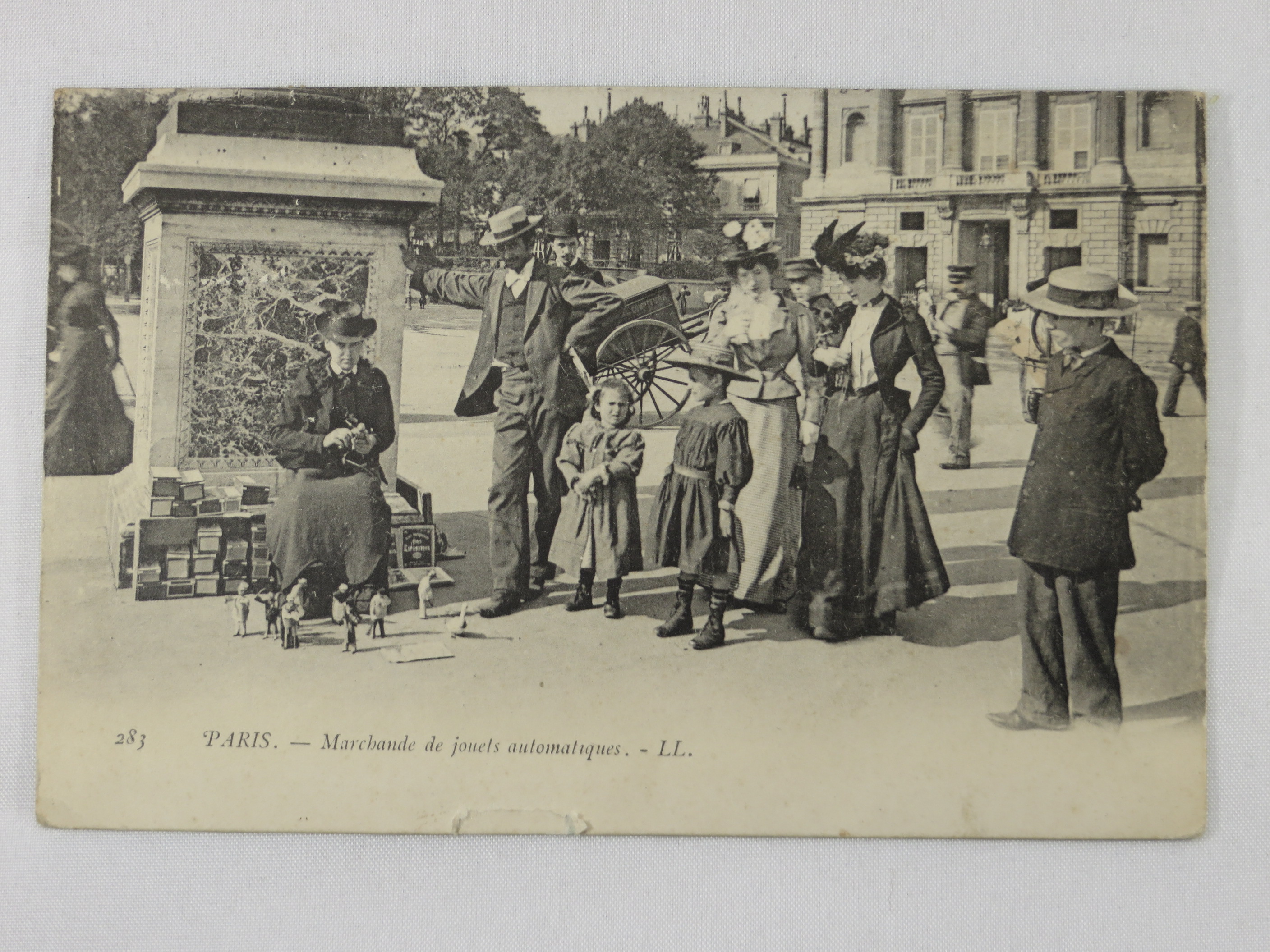
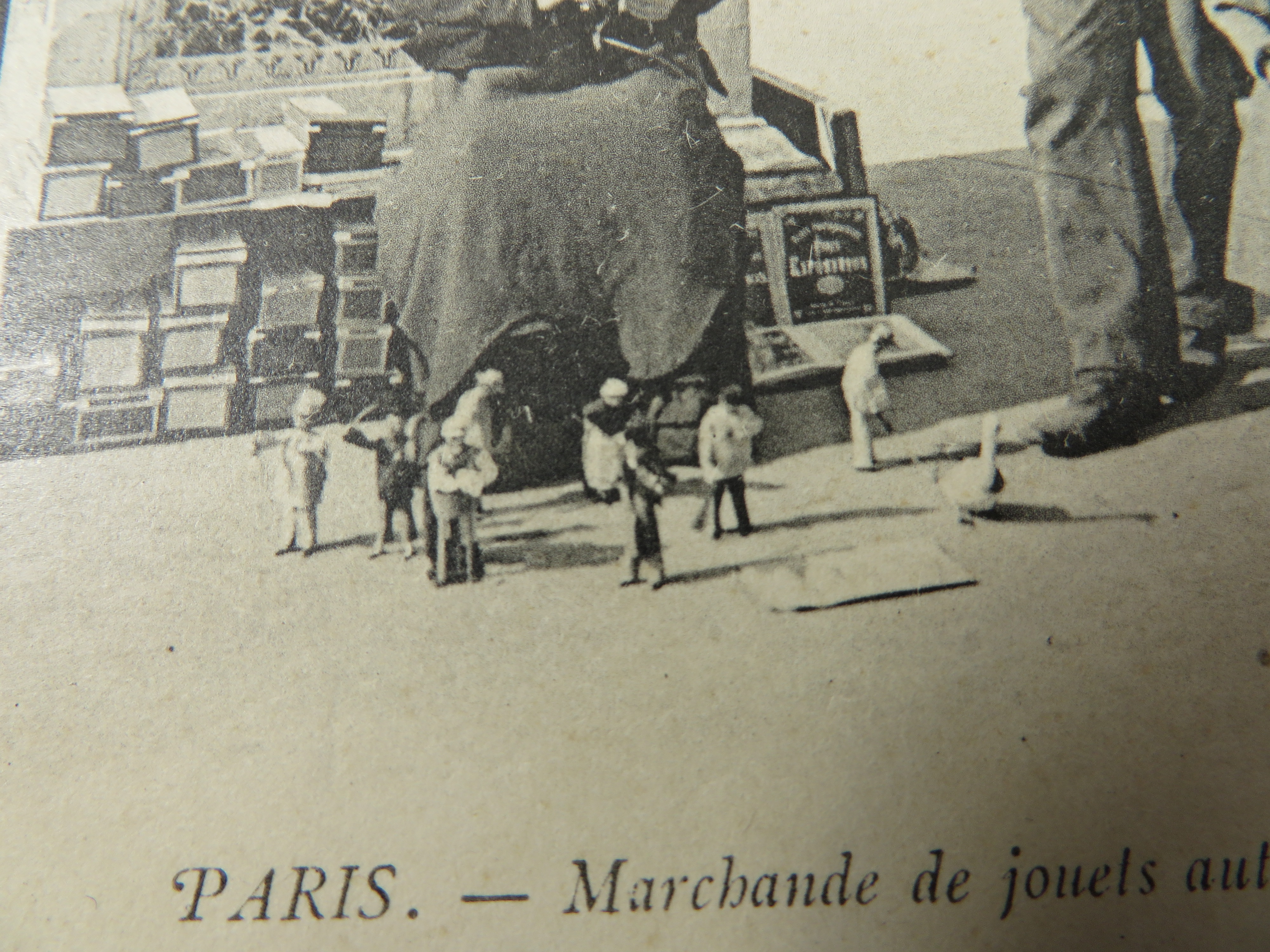
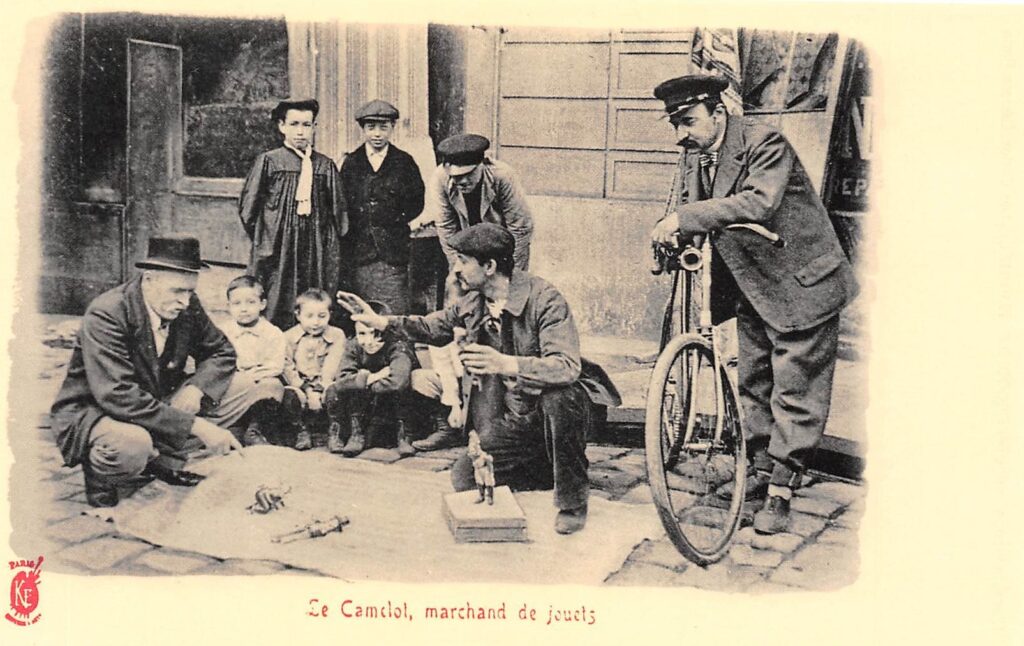
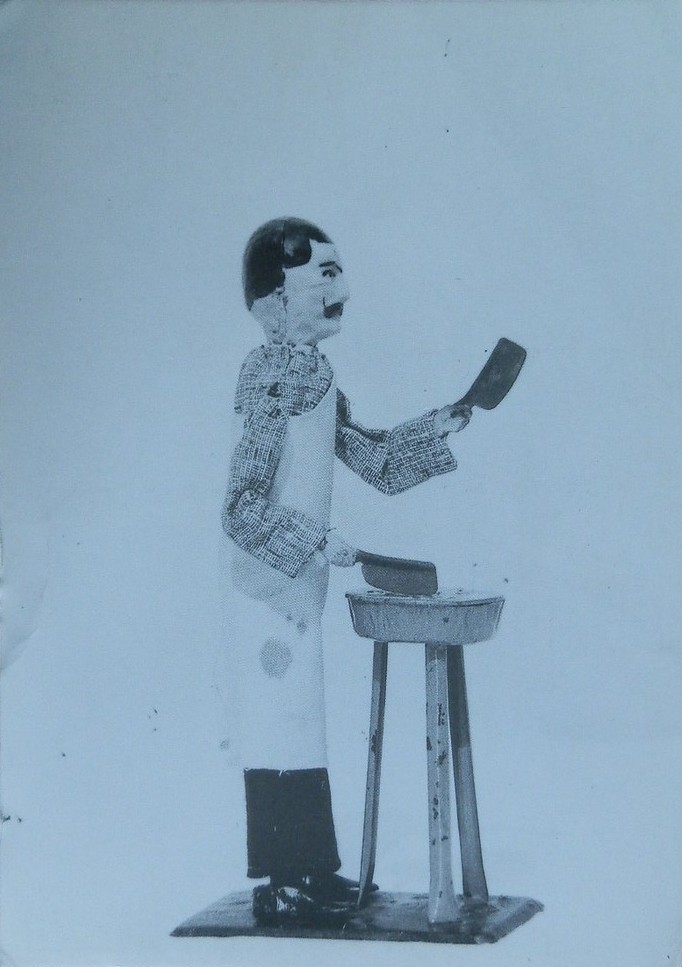
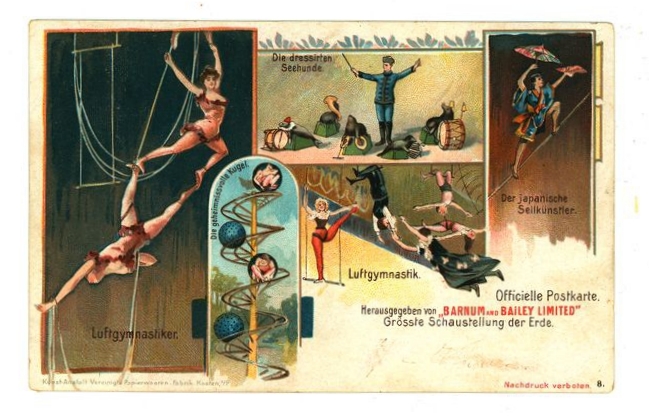
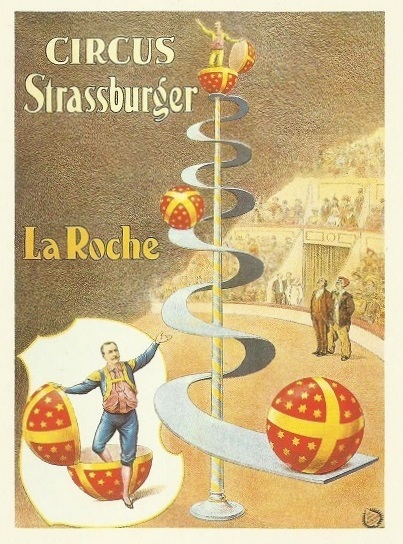
Many of us still know the time when there was no internet with e-mail and the telephone was still very rare, the postcard was then still a popular and cheap means of transferring short messages, congratulations or greetings. Nowadays, postcards are almost no longer used due to the availability of faster, cheap media. The postcard was introduced in the second half of the 19th century. On a postcard there was room for writing a message and usually there was an image on the other side. Fernand Martin’s toy has also been used a number of times as an image on a postcard. I have examples from France, Germany but also one from the U.S.A. The most of the postcards shown here are from my own collection.
detail with the Martin toys
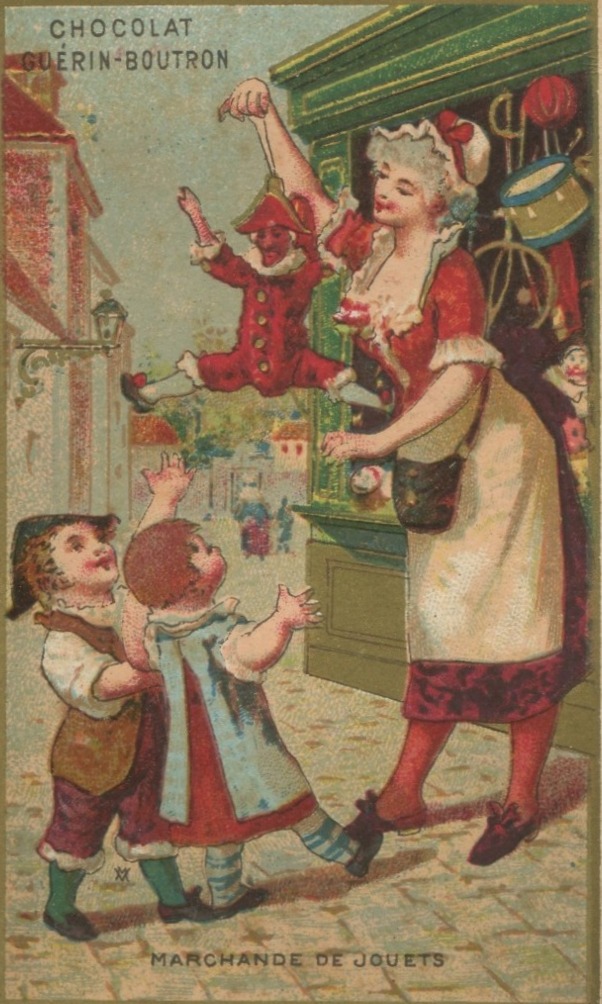
A street vendor from Paris with a stamp from 1905
French postcard with images of Martins, date unknown
Another French street vendor from the late 1800s, with the Violinist, this image was also used on a chromo collector plate. This card can be found in the hand-colored version or in black and white
A French postcard with the “Le Charcutier” date unknown
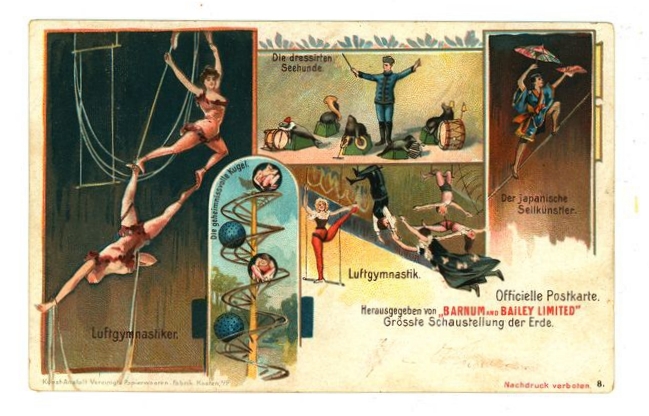
A German postcard of the circus Barnum & Bailey who toured in Europe around 1900. The “La Boule Mystérieuse” is shown on this postcard
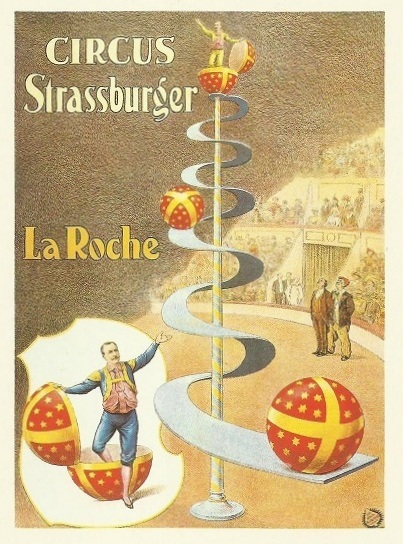
Another postcard now of the circus Strassburger from around 1914 The “La Boule Mystérieuse” is shown on this postcard
A street vendor from New York with a stamp from 1906
A postcard from 1994 with the Number 233 La casseuse d’assiettes from 1912
It is nice to collect this postcards next to the Martin toys.
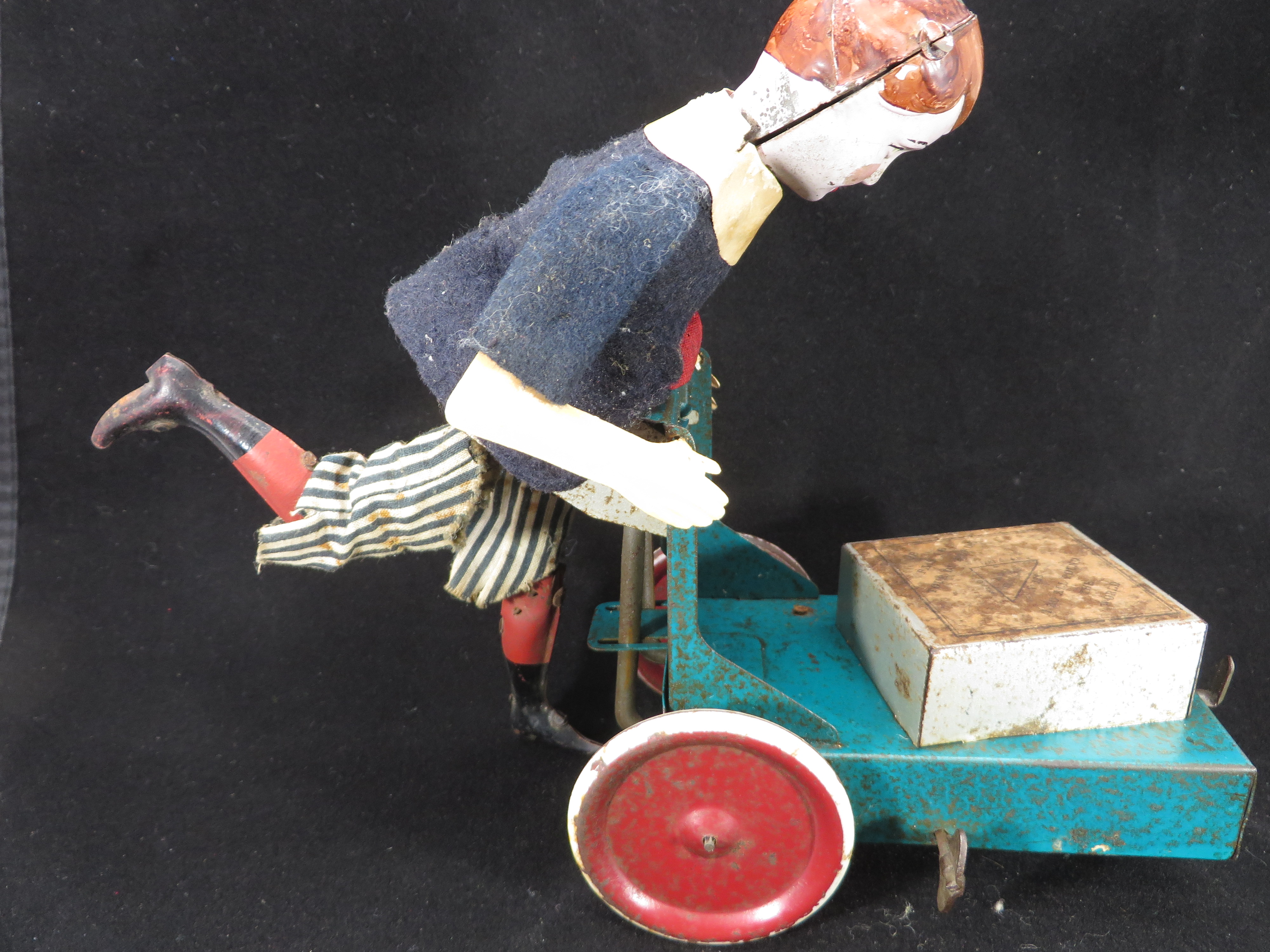
Besides the violinist and the drunkard, the le Petit Livreur is one of the most produced and well-known Martin toy. Of all the different “models” mentioned here, there are many different color versions.
Model 1: Fernand Martin made the first model with the spoke wheels and a head with “look a like” real hair in 1911
Model 2: The second known model is from George Flersheim and features the Flersheim key, another label, painted hair and the closed wheels. This model was made from 1912
Model 3: The third model was made by Victor Bonnet, this model was similar to the Flersheim model but has a different “Bonnet” key. What was also changed was the operation of the small “steering wheel” under the cart. With the Martin and the Flersheim the handle is on the left or right side and with the Bonnet usually on the front but there are still some Le Petit Livreurs with a Bonnet key and the handle also on the side. The Bonnet version also has a brass nameplate on the cart This model was produced by Bonnet from 1919 After the relocation of the factory in 1933, the brass nameplate and the paper on the case disappeared, replacing it with the new VEBE logo on the case
MODEL FROM 1919 TILL 1933
Model 4: The fourth and rarest model. In 1911/12 a separate “MARTIN” model appeared on the market, this model had a higher suitcase/trunk with advertising on it instead of the low suitcase. This case was also lithographed and could be opened Whether the labels on the suitcase can be recognized as the round logo of the “Grand Hotel” in Paris. The boy of this Petit Livreur also got a bunch of hair and a flat cap. It was suspected that this Petit Livreur was made on special order for the Gand Hotel and was sold as a tourist item to guests / visitors to the hotel. There would have been sweets in the suitcase, so it was a kind of candy container. There is still another Martin toy with such a trunk, it is the L’autopatte from 1910. These two toys are also depicted in the book: Fernand Martin Toymaker in Paris 1878-1912 from Arthur Verdoorn and Lourens Bas. on p. 223.
A collector of hotel logo’s from Portugal, told me that this “Grand Hotel Paris” logo was used at that time in 2 versions, a round and a right-angled one, by the Grand Hotel. It was used as a seal on letters and was also stuck on tourist gift items in the “Grand Hotel” gift shop. These logos waren used from the end of 1800 to the beginning of the 1st World War (WW1) in 1914. With its 700+ rooms, the hotel was the largest in Paris and was used as a military hospital in the 1st World War This hotel still exists today.
It is not exactly clear whether Fernand Martin or George Flersheim put it on the market, but I suspect Martin because it still has a typical “Martin” key, but that actually means little because Flersheim has also released toys with a Martin key, presumably using up old supplies. All in all an exceptional piece and very sought after because it is not sold in large numbers.
There is a known photo of the stall with the “normal” and the “special” Le Petit Livreur, this photo was once sold on Ebay. A question for those who have this photo: send me an image then I can add it to this article.
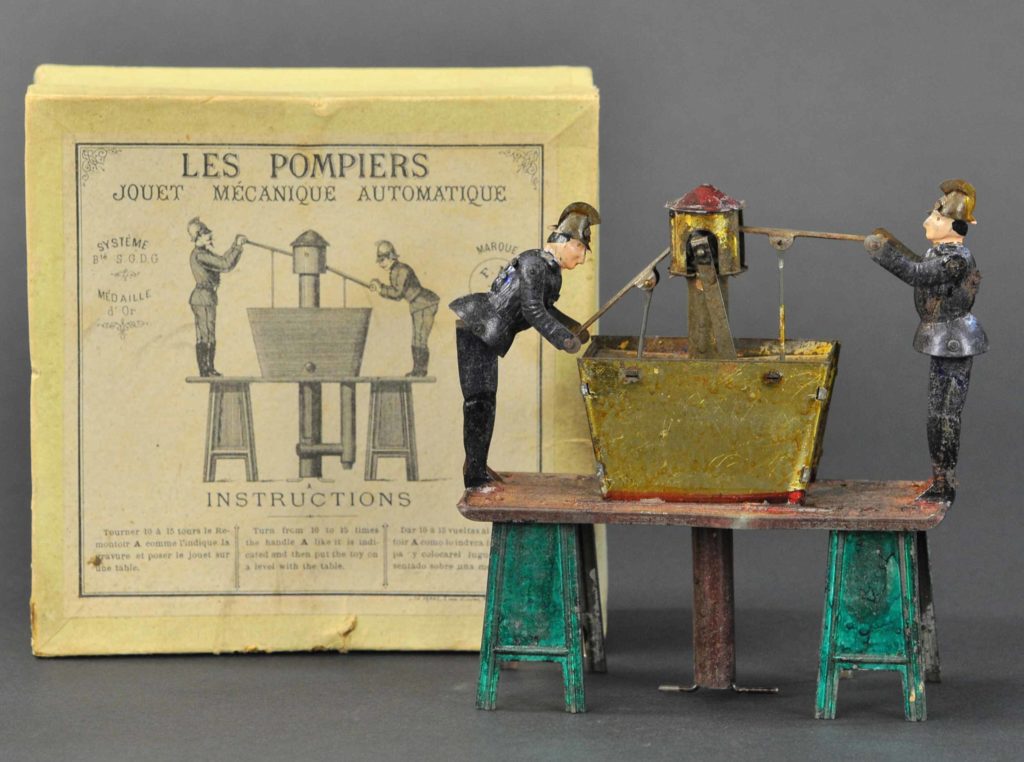
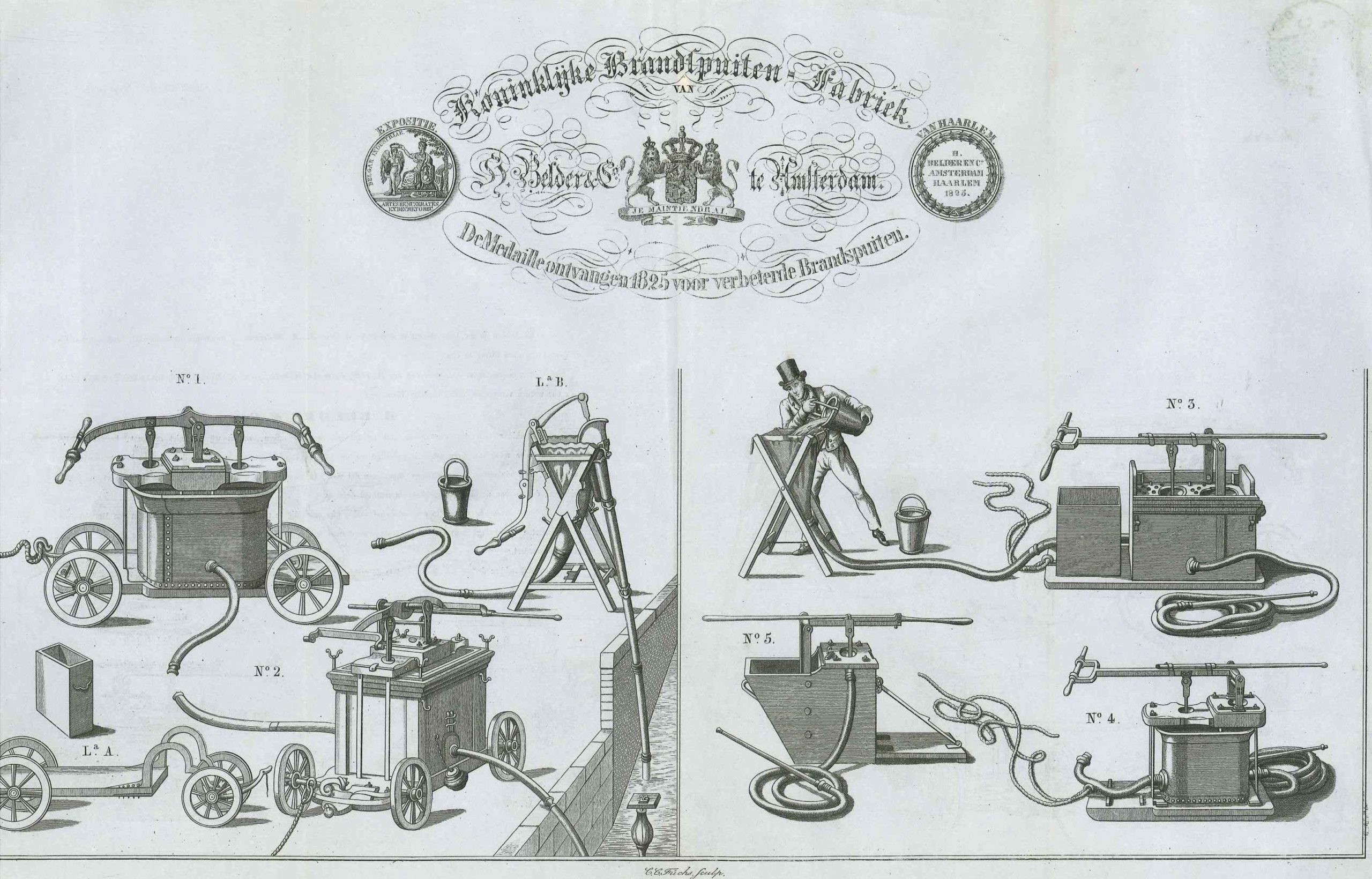
A very early toy that Martin made were two firefighters with a fire sprayer, which reflects the state of the art of firefighting at the time.
courtesy Michael Bartoia auctions
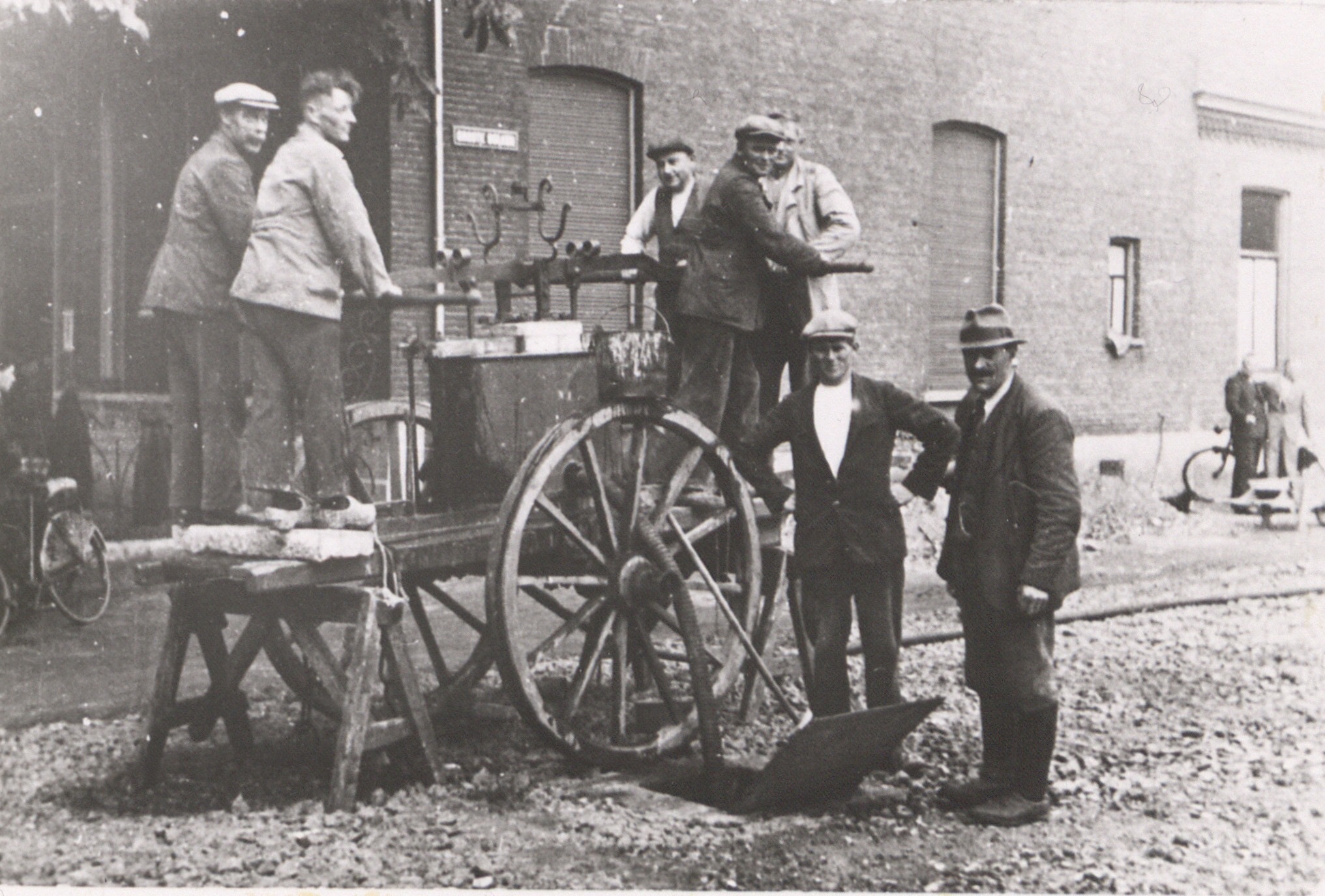
History: A fire sprayer had already been granted a patent in 1614, but the first well-functioning model comes from the Dutchman Jan van der Heiden in 1672 with a hose fire sprayer. This type of fire sprayers was sometimes used until the Second World War (WWII) Large heavy pumps used to be pulled by horses and the smaller models were pulled by firefighters themselves.
Foto with permission of BHIC ( Brabants Historisch Informatie Centrum ) s’Hertogenbosch the Netherlands, fotonumber BCV2538
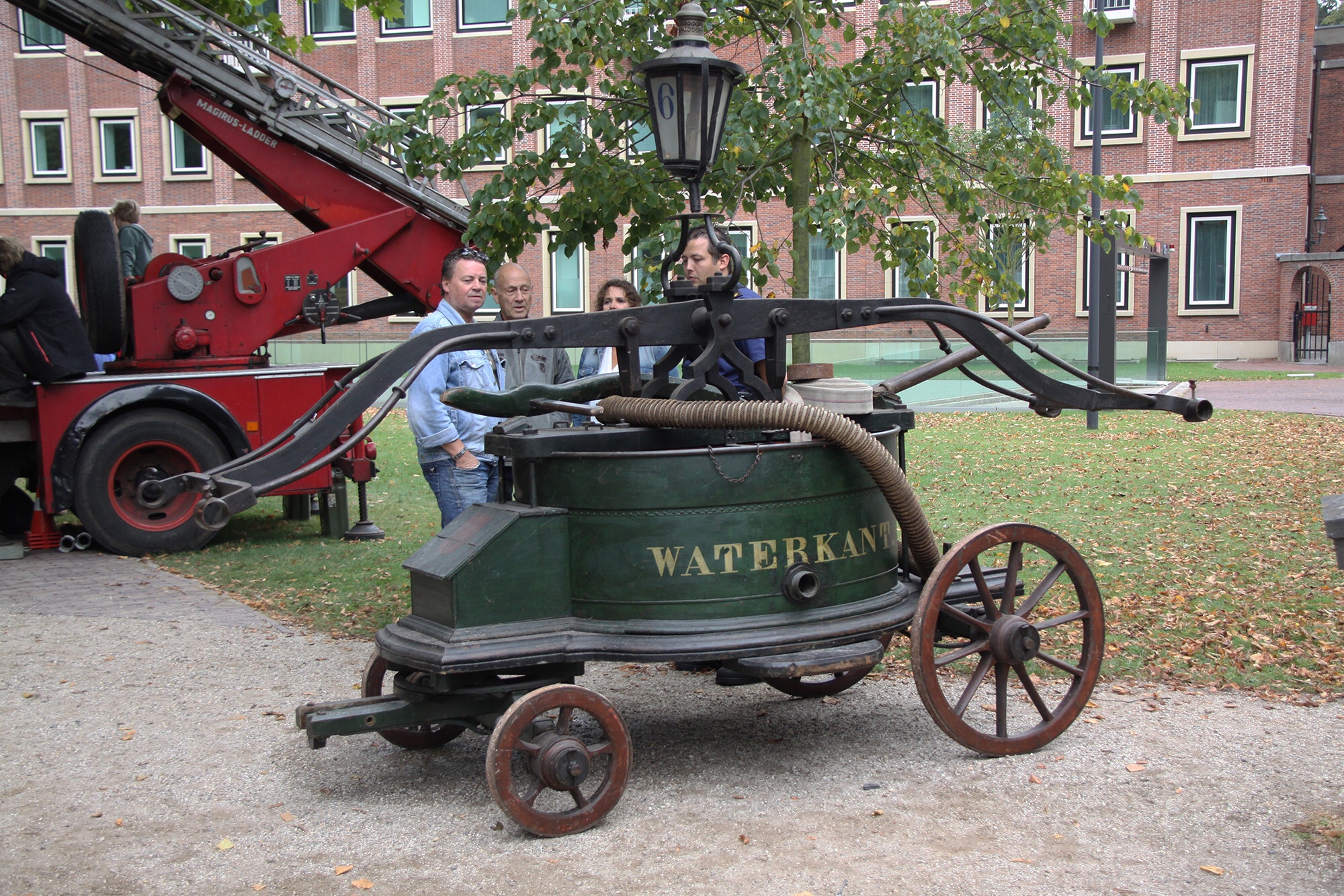
The fire sprayer can be compared to a wooden, red-copper or metal tub / container in which a hand pump with a nozzle is attached. Although this type of fire sprayer delivered a constant flow of water, it had the disadvantage that it had to be filled with buckets. There is also a type that could itself suck water from a canal or ditch. Because the hose could not be too long, it had to be placed close to the fire, which of course was dangerous for firefighters and equipment.
Foto with permission of Vincent Martin www.112heemstede.nl
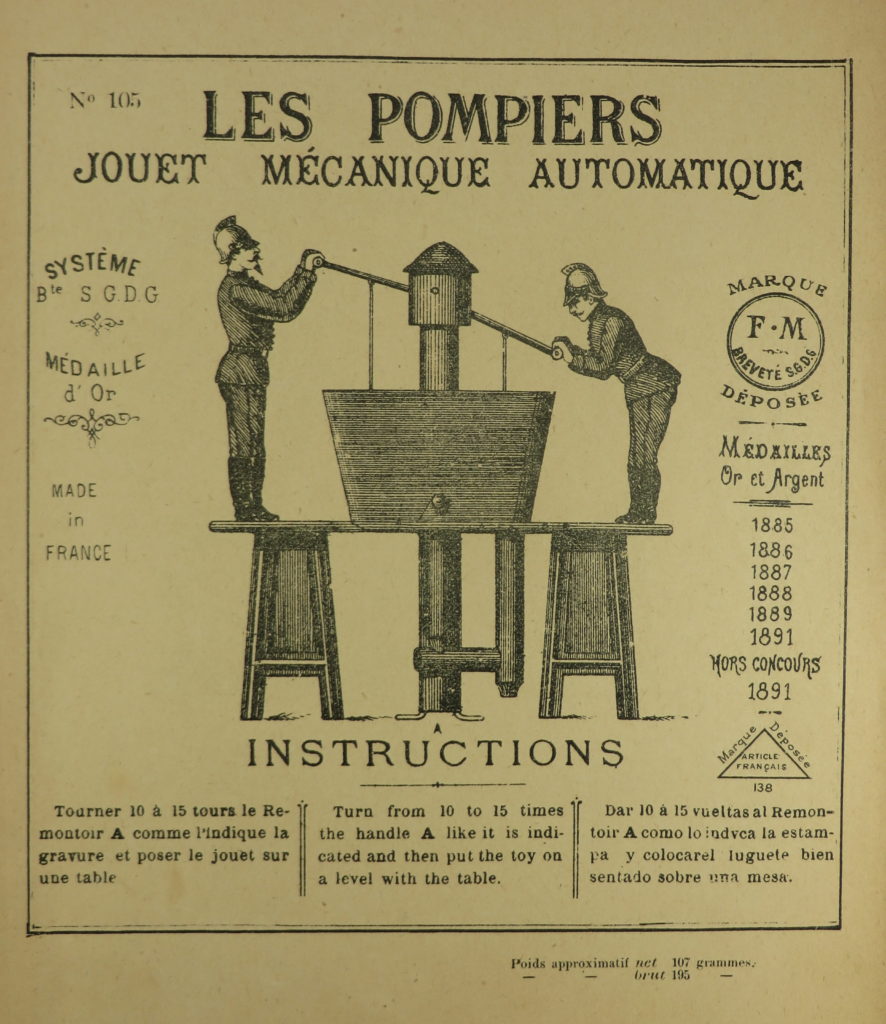
Now about the toy model. Dimensions: Height 16 cm (6-1/4 inch) Length 14 cm (5-1/2 inch). At the bottom of the storage tank, you can connect a hose. If you look at the drawing you will see an “A” at the bottom, that’s the wind-up key. After being wind up, you place this toy on the table. I don’t know if you have to fill it with water or put it in a little tub with water. Filling seems unlikely to me because the container due to the mounting tabs it would leak everywhere. Sucking up seems more likely to me, the water can then be sucked up through the pipe at the bottom.
With permission of GAGoes, municipal archive Wolphaartsdijk.
On the drawings in the catalog and the drawing on the box you see an extra pipe drawn, the water could be sucked through this pipe, on the actual toy you can no longer see this pipe but it can be integrated into the thick pipe where the wind-up mechanism is located. Both figures then move up and down and thus pump the water away through the hose.
In this small old drawing it seems that the toy is probably partially in the water up to about the plateau on which the two firefighters stand.
Here above an image from the original Fernand Martin catalog 1898 Compare this image with the image on the lid of the original box and you will see some differences.
If you look very closely you will see the next differences: 1- The two corners of the catalog image are not richly decorated. 2- On the box label there is no “triangle with number 138” 3- On the box label there are no dates of various gold medals that Martin has won 4- On the catalog image the net and gross weights are stated below the image. 5- On the left of the catalog image is the text “Made In France”. 6- The catalog image is numberd with number 105, (but more about this number in one of the following blogs).
A very rare and hard-to-find toy, the box is even rarer to find. The piece with the box on the first photo was sold at the Bertoia auction on May 9, 2019 for $ 8000 without the auction surcharge.
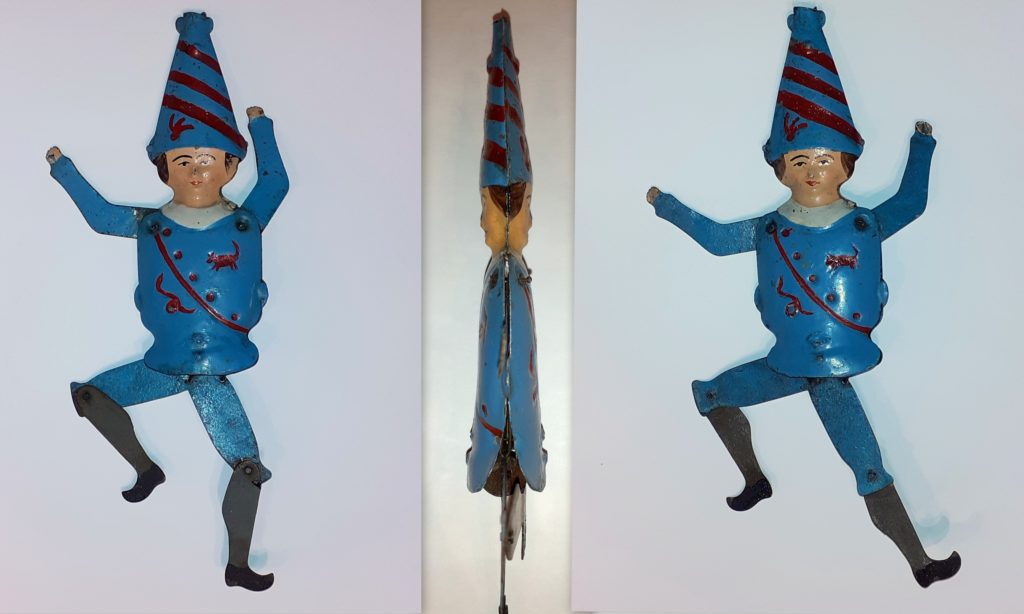
Fernand Martin has made two versions of these Harlequin figures These figures were very popular with the children at the end of the 1800s You could buy these figures from department stores, smaller toy stores, market halls and from street vendors.
picture of a collector plate
These Harlekijn dolls were for sale in various materials such as fabrics, wood and by Martin in the tin plate version
The first one he made was quite early in his career. In 1882 he made an approximately 22.5 cm (8 ¾ ”) figure, and is called “Le Pantin Mecanique” The product number is unknown (In the books known to us, this toy has the Martin product number 06, but that must is incorrecte) It is found in two color varieties in blue and in red The special thing about this figure is that it has two faces, one at the front and one at the back The mechanic was by a rubber band drive In the museum in Paris Musée des arts and Métiers – Le cnam, the red one can be found, it was in the gift from Fernand Martin to the Museum As the photos of the museum contain a copyright, I cannot show it here, but a digital visit to the site is worth looking at, see this link: https://phototheque.arts-et-metiers.net/?idPageWeb=95 enter the keyword “Fernand Martin” at “rechercher”. The photo you can find at number 0001664-143
Here the blue one, the photos are from the : front – side – back You can see that the front and back are both with a face Photos with thanks to the Toy Museum Soltau (“Spielmuseum Soltau”) in Germany
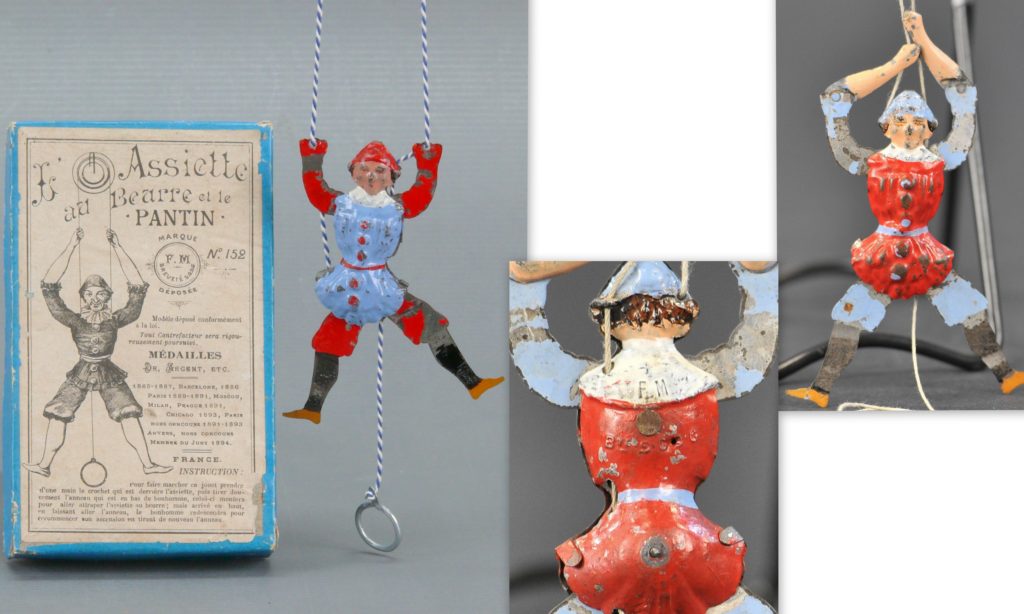
The second version was made from 1896, so in the second period of Fernand Martin. The product number is 152 and the name is “L’assiette Au Beurre Et Le Pantin” This is also known so far in two color varieties in Blue / red and in Red / blue It is quite small and only around 10 cm (4”) in size, the drive is here through a pull rope If you pull this, the arms and legs start to move, Lehmann also had a similar effect with his well-known Climbing monkey. This figure does have a clear front and back
Left the Le Pantin with box from the Toy Museum Soltau (“Spielmuseum Soltau”) in Germany collection, the other two photos courtesy of Michael Bertoia Auctions
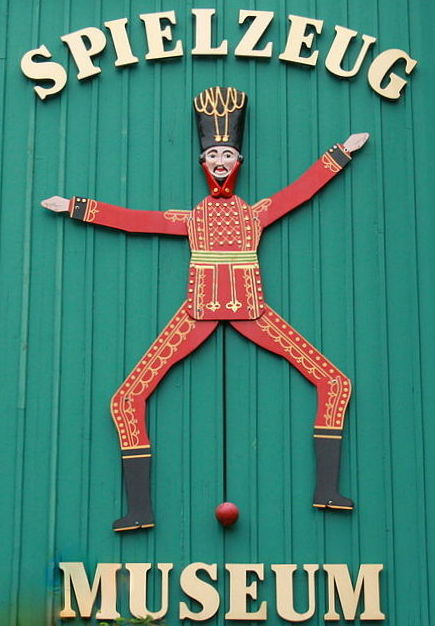
Soltau, a small town located in the north of Germany, just an hour’s drive from Hamburg. In the center of Soltau, spread out across two buildings (Poststrasse 7 and 15), is one of the most exiting toy museums I know.
Welcome to the Toy Museum Soltau (“Spielmuseum Soltau”), a house full of treasures, dreams and ideas! The museum houses one of the best and most varied toy collections in the world: from a huge all-original Victorian dolls house with fifteen fully furnished rooms to a great Humpty-Dumpty circus set, from William & Mary wooden dolls to mechanical tin toys and from Erzgebirge scenes to paper toys.
The hairdresser is already talking a lot about this great museum.
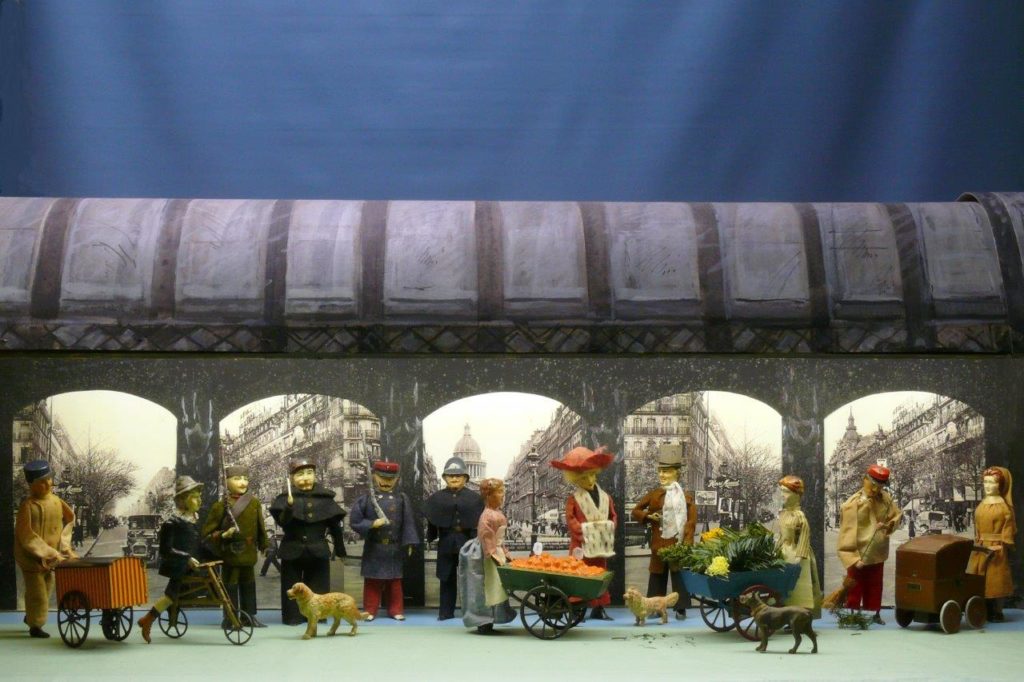
And it will get even better: at the end of March 2020 a special department dedicated to a large collection of Fernand Martin toys will open at the Poststrasse 15 branch of the museum. This department will be named “Klein-Paris!” (Little Paris!): a new exhibition unit with fantastic French toys from the turn of the (1900) century is currently under construction. The focus is on mechanical sheet metal figures by the famous Paris toy maker Fernand Martin.
Even on the street this is the talk of the day.
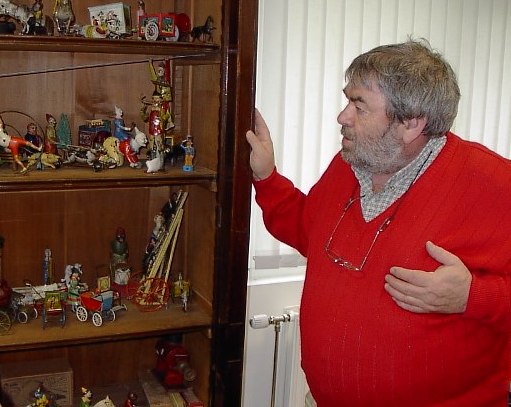
All objects come from the great collection of Arthur Verdoorn and were donated to the “Stiftung Spiel” (Foundation for Play) that runs the museum. Arthur Verdoorn was a Dutch collector and a personal friend of mine, he was one of the two authors of the fantastic book: “Fernand Martin Toy Maker In Paris 1878-1912”.
I know his collection very well and I often played together with him, in his own home museum, with these toys.
Arthur Verdoorn with his beloved toys
A very large collection that fortunately can be admired by everyone soon.
The Spielmuseum Soltau is not just a museum to look at: visitors of all generations are invited to explore, enjoy, try out, play and learn. So, step into history, reminisce and get inspired! The museum is open 365 days a year from 10 am to 6 pm and the exhibitions cover a total of 900 square meters.
Now we just have to wait for the train to Soltau
And have you decided to take a look and travel to Soltau? Then don’t miss the nearby felt museum “felto – Filzwelt Soltau” and be surprised there, too – for example by more than 120 historic Steiff character dolls all made of felt.
In principle there are four different Martin bears, three are produced under the same number 193 in a period of more than 25 years. They are very similar in appearance, there are two colors, white and brown. The fourth is a completely different bear with number 216
Three bears, who carry the same number: What do you need to know if you have one or want to purchase one or even find one. What should you pay attention to!
The first one is the brown bear with a “hairy” head, so it looks like a head with fur. This was given number 193 and was made by Fernand Martin in the second Martin period in 1904. Marked under one leg with “FM” and under the other leg with the famous “triangle” and equipped with a “Martin” key
First one from 1904 by Fernand Martin
The second one is the same bear but in a white version, the head is now painted white. He received the same production number and was made by Fernand Martin in the second period from 1909 But was also produced by Victor Bonnet in the fourth period with the same number If it is produced by Fernand Martin then one leg is marked with FM and under the other leg with the famous triangle.
Second one from 1909 by Fernand Martin
If it was produced by Victor Bonnet from 1921 until the 30s, it is marked under one leg with “VB & Cie Paris” and under the other leg with “Made in France” and equipped with a “Victor Bonnet” key
The second one from 1921 by Victor Bonnet
The third version is a brown bear but now with a dark brown painted head, this bear was produced by George Flersheim in the third period from 1912, this bear also received production number 193. Marked under one leg with “FM” and under the other leg with the famous “triangle” and equipped with a “Flersheim” key
The third one from 1912 by Georges Flersheim
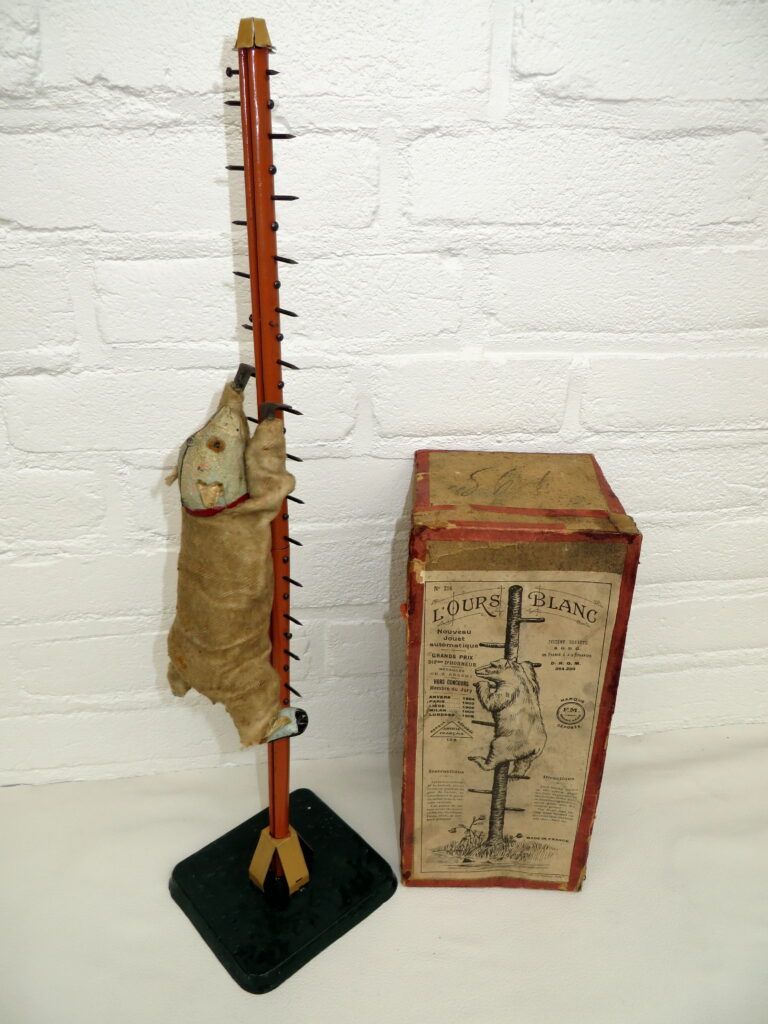
And then there is a fourth bear It is the climbing bear and was produced by Fernand Marin in 1909 The production number is 216 This is a very special bear that, after winding, climbs independently into a pole.
The fourth one from 1909 by Fernand Martin
All toys shown in the photos are or were from my own collection
Vrolijk Kerstfeest en een Gelukkig Nieuwjaar Merry Christmas and a Happy New Year Fröhliche Weihnachten und ein glückliches Neues Jahr Joyeux Noël et Bonne Année Feliz Navidad y Próspero Año Nuevo Buon Natale e Felice Anno Nuovo Boas Festas e um feliz Ano Novo Kala Christougenna Ki’eftihismenos O Kenourios Chronos God Jul och Gott Nytt År Glædelig Jul og godt nytår Geseende Kerfees en ’n gelukkige nuwe jaar Hyvää joulua ja onnellista uutta vuotta
A piece of a French Christmas wish advertisement from a Paris toy department store in the early 1900s
This very ingenious toy is a reproduction of reality, it was a circus act from the late 1800s and early 1900s
A piece of history :
This act was performed by an Austrian artist Leon Rauche with his artist name La Roche or LaRoche LaRoche started at Barnum & Bailey in 1895 The world famous circus Barnum & Bailey had this act in its program from 1895 to 1903. In 1897, James A. Bailey, as Director of the Barnum and Bailey show, decided to organize a multi-year tour in Europe. In October of that year, he arrived in England with his complete circus company and began his performance at the Olympia Hall in London. He traveled throughout England to cross the mainland of Europe. After visit many cities in Central Europe, the circus returned to America in 1903.
Original circus poster “LaRoche and His Mysterious Ball” Picture with approval of: Poster Auctions International Inc. NYC
This poster is dated 1897 and that is because almost all images for this European tour were pre-produced in 1897 in America at: “THE STROBRIDGE LITHO CO. “In Cincinnati; Ohio. In countries where the circus stayed for a long time, the text was adapted to the national language. The amount of posters taken for this tour was more than 100,000 sheets. Should a certain stock run out, then according to the American design, sheets were printed in Europe. In exceptional cases, local designers and printers were sometimes called upon.
The show was in Paris in the period of November 1901 – March 1902 Housed in the Salle des Fêtes of the Galerie des Machines at the foot of the Eifel tower, a remnant of the 1900 exhibition in the Champ-de-Mars. Barnum & Bailey presented its show consisting of a large number of first-class attractions. The first show took place on November 30, 1901. Barnum & Bailey was sold out until March 23, 1902. The shows took place every day at 8:15 pm, with matinee at 2:00 pm, Sunday, Wednesday, Thursday and public holidays.
I think Fernand Martin also visited this show in Paris, but he didn’t come up with the La Boule Mystérieuse at that time, why?? read more…..
German postcard from the European tour 1897 – 1903
The invention of the act :
Leon Rauche (Laroche) has designed this act himself. Legend has it that circus contortionist Leon LeRoche got his inspiration for ‘La Boule Mysterieuse’ from a popular gambling game that took place outside the tent of a show in Romania. After bettors bet on one of multiple numbers, the showman rolled a ball from the top of a 1 foot high spiral, screaming as the ball rolled its way to the winning number. LaRoche’s had a 12-foot spiral built for his own act. While he was locked up in a metal ball of 2 ½ feet in diameter, he slowly and mysteriously rolled up and down on a spiral track without railing, and without the help anything visible or a motor. The mystery of its progress is supposed to be explained when the man comes out, but it is more mysterious than ever, for the man has to tie himself in a knot to get into the sphere and certainly does not appear to have room to budge an inch , and the reason why the ball goes up and down slowly is just as inexplicable as ever! “.
The trick was considered “an inscrutable mystery,” a sudden genius. Everywhere the show agents arranged performances of this wonderful man and his company. LaRoche doubled the height of the spiral to 24 feet and by the time he started touring with Barnum and Bailey in 1896, the course was already 30 feet high. After the circus went back to America in 1903, La Roche left Barnum & Bailey and presumably continued with his act to the “Strassburger” circus. This circus existed from 1892 to 1963
Postcard from 1914
The toy :
Fernand Martin came on the market in 1906 with his “La Boule Mystérieuse” and it was a great success.
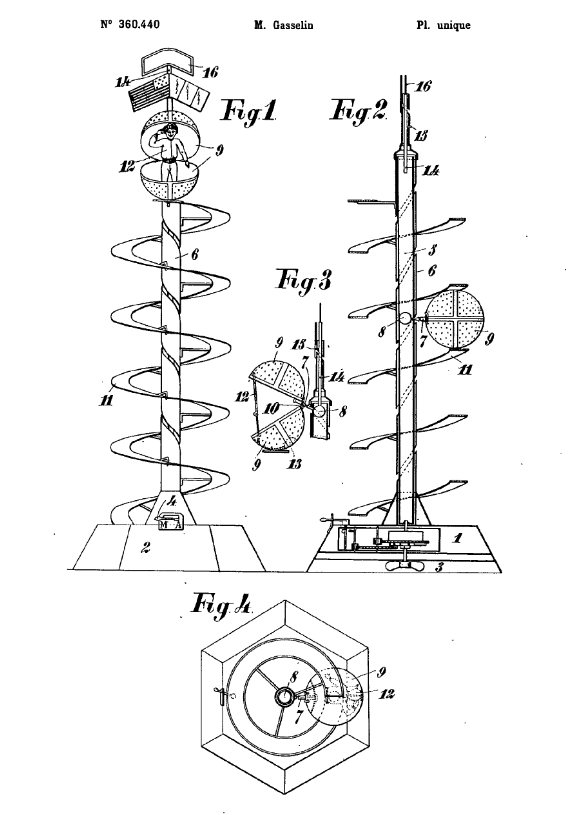
But Fernand Martin was not the original designer/inventor of this toy. On 6 December 1905, a French inventor Mr M Celestin Gasselin applied for a patent under patent number 360440. It was granted on February 23, 1906, and on April 21, 1906, this patent was published.
This is a part of the original published patent
Fernand Martin purchased this patent directly from Mr. Gasselin and put it on the market in 1906. This toy was registered in Germany under a patent number D.R.G.M. 269277 The “Martin” number of this toy is 204
Sinds 25 mei 2018 is de Algemene verordening gegevensbescherming (AVG) van toepassing. Dat betekent dat in de hele Europese Unie (EU) dezelfde privacywetgeving geldt. De Wet bescherming persoonsgegevens (Wbp) geldt niet meer.
In het kader van deze Algemene verordening gegevensbescherming die per 25 mei 2018 in werking is getreden, informeren wij u hoe https://www.fernandmartintoys.nl. omgaat met uw persoonsgegevens.
Welke gegevens verwerkthttps://www.fernandmartintoys.nl. Uw persoonsgegevens worden verwerkt doordat u gebruik maakt van onze diensten en/of omdat u deze zelf aan ons verstrekt. Hieronder een overzicht van de persoonsgegevens die wij verwerken: • Voor- en achternaam. • Adresgegevens. • E-mailadres.
We kunnen niet controleren of een bezoeker die via de website is aangemeld 16 jaar of ouder is. Als u er van overtuigd bent dat wij zonder die toestemming persoonlijke gegevens hebben verzameld over een minderjarige, neem dan contact met ons op via cor@vanschaijk.com.nl dan zullen wij deze informatie verwijderen.
Waarom https://www.fernandmartintoys.nl. uw gegevens nodig heeft Wij verwerken uw persoonsgegevens voor onderstaande doelen: • het verstrekken van informatie. • het reageren op uw bericht.
Hoe lang bewaart https://www.fernandmartintoys.nl. uw gegevens? https://www.fernandmartintoys.nl. zal uw persoonsgegevens in ieder geval bewaren gedurende de bewaartermijnen van de Nederlandse wetgeving en zo veel langer als nodig is om goede service te kunnen leveren.
Met wie deelt https://www.fernandmartintoys.nl. uw gegevens? https://www.fernandmartintoys.nl. verstrekt in principe geen persoonsgegevens aan derden. Gegevens worden uitsluitend aan derden verstrekt als dit nodig is voor de uitvoering van onze overeenkomst met u of om te voldoen aan een wettelijke verplichting.
Websitebezoek | Cookies | https://www.fernandmartintoys.nl. gebruikt alleen technische en functionele cookies en analytische cookies die geen inbreuk maken op uw privacy. Een cookie is een klein tekstbestand dat bij het eerste bezoek aan deze website wordt opgeslagen op uw computer, tablet of smartphone. De cookies die wij gebruiken zijn noodzakelijk voor de technische werking van de website en uw gebruiksgemak. Ze zorgen ervoor dat de website naar behoren werkt en onthouden bijvoorbeeld uw voorkeursinstellingen. Ook kunnen wij hiermee onze website optimaliseren. U kunt zich afmelden voor cookies door uw internetbrowser zo in te stellen dat deze geen cookies meer opslaat. Daarnaast kunt u ook alle informatie die eerder is opgeslagen via de instellingen van uw browser verwijderen.
Uw gegevens inzien, aanpassen of verwijderen
Op schriftelijk verzoek is het mogelijk uw persoonsgegevens in te zien
en/of aan te passen. In bepaalde gevallen en indien daarvoor goede
redenen zijn, kunt u vragen om uw persoonsgegevens te wissen mits de wet
dit toelaat.
Beveiliging https://www.fernandmartintoys.nl. neemt de bescherming van uw gegevens serieus en neemt passende maatregelen om misbruik, verlies, onbevoegde toegang, ongewenste openbaarmaking en ongeoorloofde wijziging tegen te gaan. Als u de indruk heeft dat uw gegevens niet goed beveiligd zijn of er aanwijzingen zijn van misbruik, neem contact op via cor@vanschaijk.com