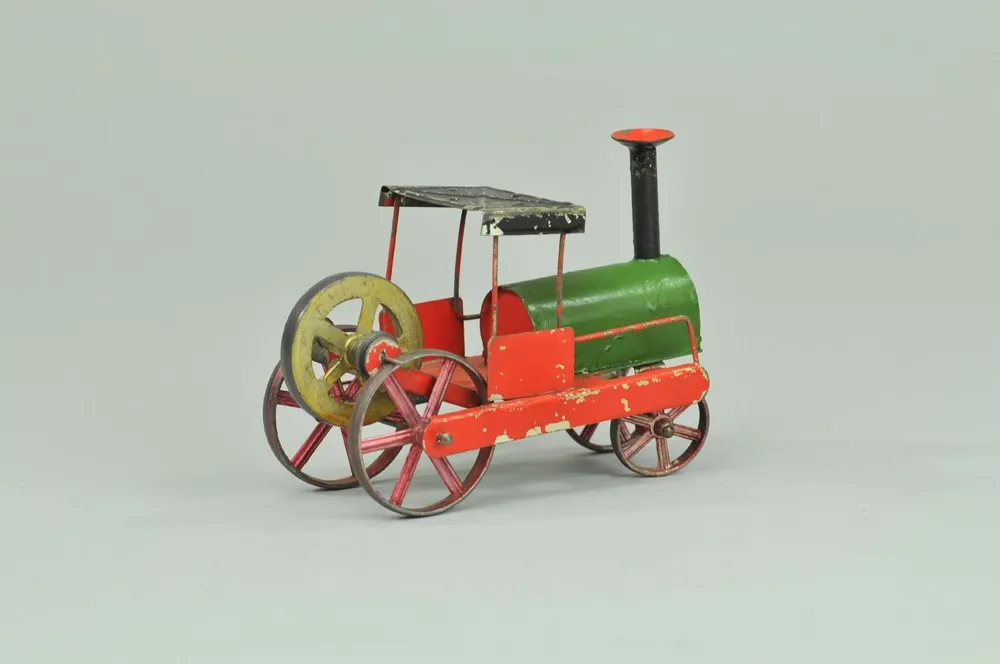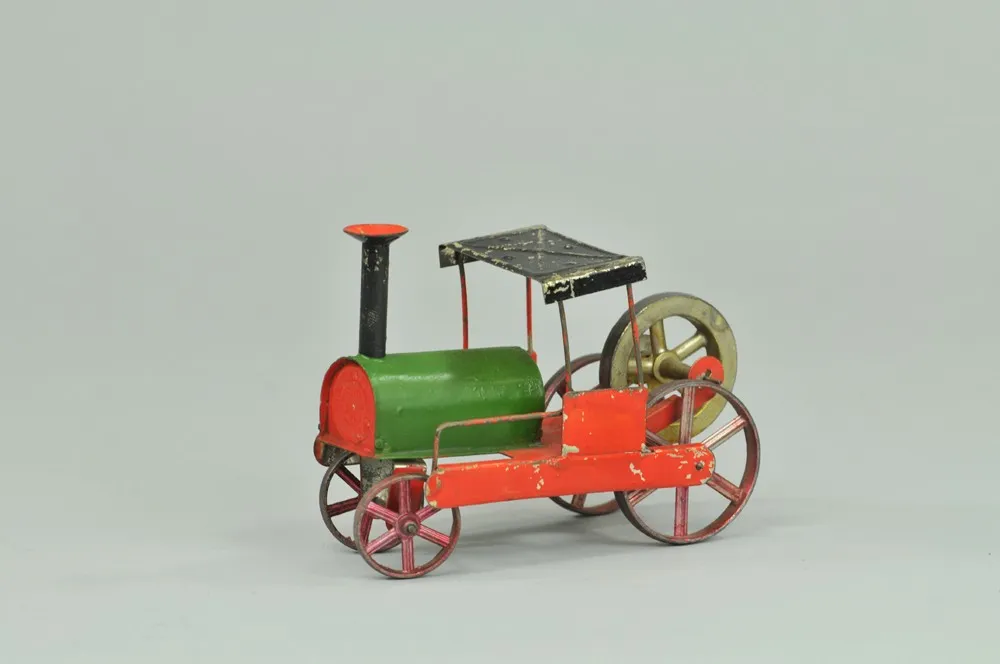
Produced from 1883
Product number unknown (In the books known to us, this toy has the Martin product number 09 which is not correct, this locomotive has probably not been given a product number. )
Hand lacquered
Marked on the small chimney with the FM logo
Flywheel drive – a floor train that does not need rails.
Length approx. 14.5 cm / 6 inches
Height approx. 9.5 cm / 3.75 inches
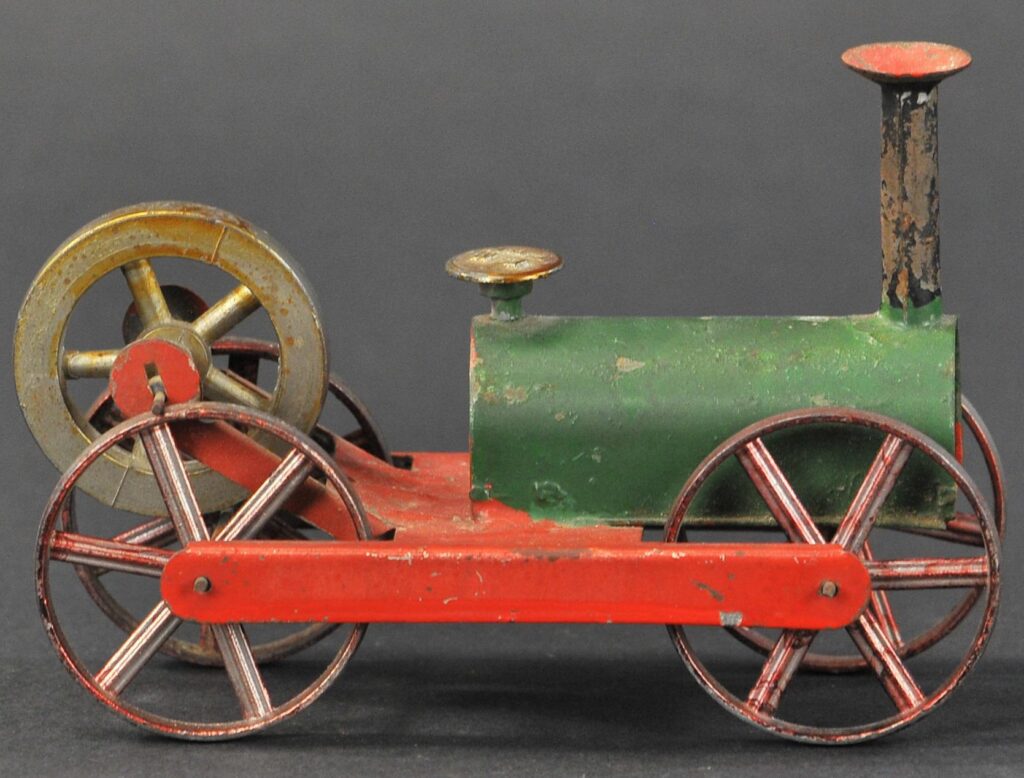
The technique of the movement of this locomotive :
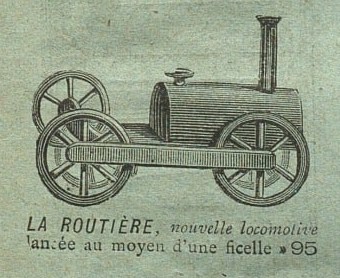
A free translation of the article from La Nature 1884 page 80
A MECHANICAL TOY THE ROAD LOCOMOTIVE.
It seems interesting to discuss the operation of toys when the opportunity will present itself.
Today we would like to present to our readers a very simple and ingenious machine, known in the trade as a road locomotive, and which clearly emphasizes the principles of inertia and living force.
We know that to obtain a certain velocity from a given mass, it is necessary to expend under mechanical work a certain amount of energy, an energy proportional to the mass of the body and the square of the velocity we give it.
We know also that bodies animated at this speed do not return to the state of rest until they have expended this amount of life force in some form – this is the name given to the energy possessed by the body in motion as a result of this movement – either by friction or by performing other mechanical work, etc.
It is thanks to the living force that the billiard balls roll, that the cannon ball travels and so do spinning tops and gyroscopes.
Movement of the latter only has such a long duration because friction is kept to a minimum, they rotate at high speed and therefore have a large amount of live force that does not just go out very slowly.
We shall be able, by the aid of this lively force, to set in motion a wheel on any driving system, and ultimately to effect the progress of the whole, as in the little apparatus shown below.
It basically consists of a flywheel to which a rapid rotational motion is given using a string that is rolled around its axis and then pulled rapidly, as in their buzzing tops or magic tops.
The axle that supports this movement is mounted on the two rear wheels of the vehicle; the edge of each of these wheels is coated to increase the adhesion between the axle and the wheel.
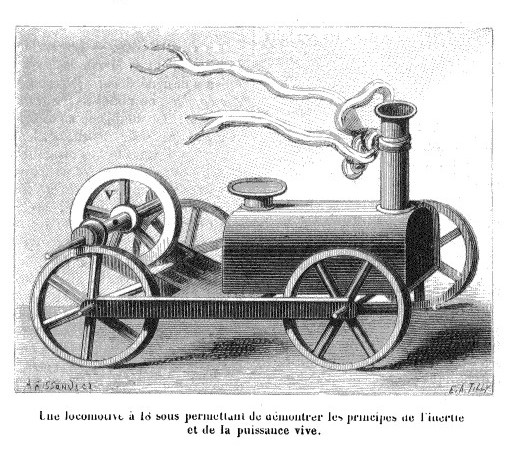
Since the axle has a diameter of about one millimeter and the wheel about 50 millimeters, this results in that, for one revolution of the handlebars, the rear wheels are driven at about 1/50 of a revolution, but the initial speed of the flywheel is very high , this has the effect of driving the wheels quite quickly, and when the system is placed on the ground, its translation also takes place at a regularly decreasing speed, as the rotation, and therefore the active force of the steering wheel, decreases.
Ensure that the parquet floor is properly flat, but it is possible to let the machine run for 20 to 30 meters before it stops.
It is needless to add that the body of the boiler and the chimney are for form only; only the rear wheels drive, the front wheels only carry wheels.
This small toy, at a very low price, can therefore be used to demonstrate the most important laws of mechanics and to prove once again the principle of energy conservation.
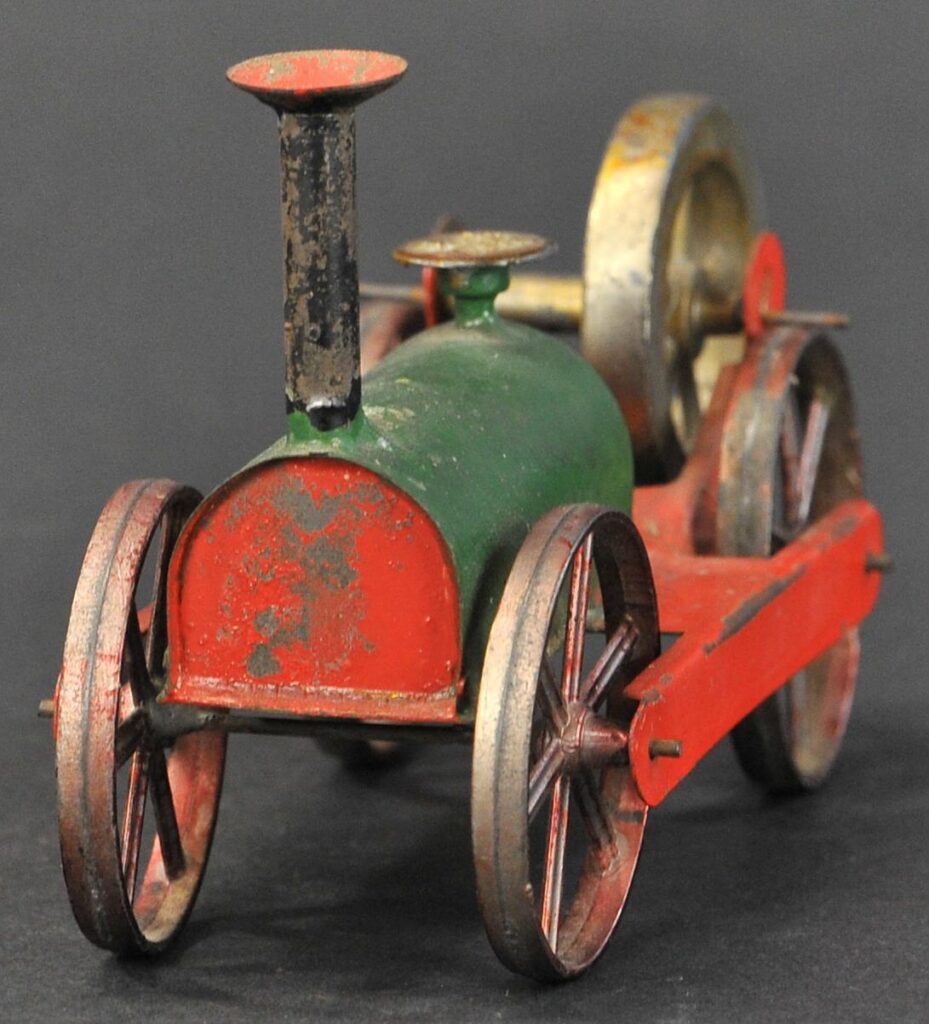
Another rare version has been found in the Bertoia auction in March 24 -2012 that has some deviations from this model.
It has a roof, no small chimney with the FM logo, and the front wheels are small.
The front wheels are adjustable so that it can also drive in a circle
The sizes and colors would be the same.